What if that sudden stop on your staircase isn’t a broken motor, but simply a safety sensor doing its job? We understand the frustration and worry that come when your mobility equipment acts up. Feeling trapped on one floor or stressing over a $450 repair bill can take away the comfort you should feel in your own space. You deserve to move through your house with total confidence and safety.
The good news is that many common stairlift problems are simple to solve with a neighborly troubleshooting approach. This guide will help you identify the most frequent issues so you can regain your independence and peace of mind. We’ll walk you through understanding digital error codes, checking for obstructions, and knowing when to call a factory-trained expert. To get your lift back in peak condition right away, you can Get Your Free Same-Day Estimate and stay in the home you love.
Key Takeaways
- Most service calls are actually simple fixes related to power supply or battery health, which typically lasts 3 to 5 years.
- Learn how safety sensors protect you from pets or debris and how to reset them when they stop your lift mid-flight.
- Discover how to address common stairlift problems like track oxidation caused by Indiana humidity with a simple maintenance routine.
- Understand when it’s safe to troubleshoot on your own and when you should call a factory-trained expert for a professional repair.
- Reclaim your freedom and peace of mind by following our checklist to ensure your lift stays reliable for years to come.
Understanding Common Stairlift Problems and Why They Happen
When your stairlift stops moving, it can feel like your world has suddenly shrunk to a single floor. We know that feeling of worry, but it’s helpful to remember that these units are complex safety machines. They are intentionally designed to stop at the slightest anomaly to keep you from harm. Most common stairlift problems aren’t actually mechanical failures. Instead, they are safety features or power issues that you can often resolve with a little bit of guidance. Understanding What is a Stairlift? and how its internal sensors work is the first step to reclaiming your independence at home.
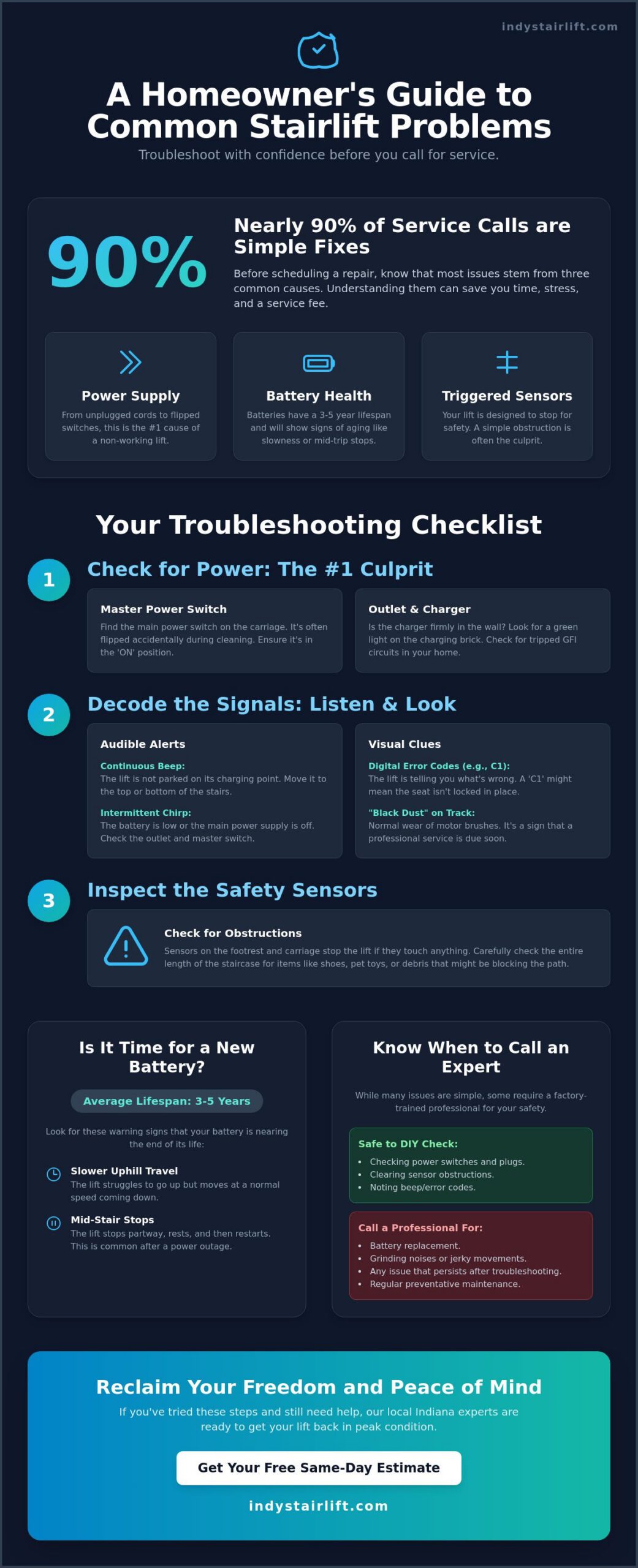
Nearly 90% of the service calls we receive at Indiana Home Safety & Mobility involve three simple things: power supply, battery health, or a triggered safety sensor. These systems work together to ensure that you never travel on a lift that isn’t 100% secure. Modern lifts are smarter than ever before. They use audible beeps or digital codes to “talk” to you and explain exactly why they’ve decided to take a break. Learning this language can save you a service call fee and get you back to your routine in minutes.
Decoding the Beeps and Error Codes
Modern units from high-quality manufacturers use digital codes to tell you exactly what’s wrong. You’ll usually find a small LED diagnostic display on the carriage or near the power switch. A code like “C1” might simply mean the seat isn’t fully swiveled into the locked position. If you hear a continuous beep, your lift is likely crying out for a charge because it isn’t parked correctly on its charging station. An intermittent chirp, on the other hand, often signals that the battery is getting low or the power cord has been bumped out of the wall. Checking these codes first is the easiest way to handle common stairlift problems without stress.
Mechanical vs. Electrical: Identifying the Source
It helps to know if your trouble is electrical or mechanical. If your control panel is completely dark and the lift won’t budge, you’re likely facing an electrical failure or a dead battery. Mechanical issues feel different. You might notice jerky movements or hear a grinding sound as the chair moves along the rail. One specific sign to watch for is a fine layer of “black dust” near the motor. This usually comes from the carbon brushes inside the motor wearing down over time. While it’s a normal part of aging, it means it’s time for a professional checkup to ensure your continued safety. If you’re unsure about what your lift is trying to tell you, you can always Get Your Free Same-Day Estimate to have a local expert from Indiana Home Safety & Mobility take a look.
Power and Battery Failures: The #1 Cause of Service Calls
It’s a sinking feeling when you press the button and nothing happens. Don’t panic. Your stairlift is actually a battery-powered device. Even if your home has electricity, the lift relies on DC batteries to move. This design ensures you aren’t stranded during a power outage, which is a requirement in official safety standards. If the batteries aren’t charging, the lift will eventually run out of energy and stop.
Before you worry about high repair costs, check the master power switch. You’ll usually find it on the main carriage or the bottom of the seat. It’s easy to accidentally flip this switch while cleaning or vacuuming. It’s a simple, no-cost fix that resolves many common stairlift problems in seconds. We always recommend checking this switch first before calling for a technician.
Checking the Power Supply and Charger
The next step is to follow the cord to the wall. Is the transformer plugged in? Many Indiana homes have stairlift outlets in basements or hallways that use GFI (Ground Fault Interrupter) circuits. If another appliance trips that circuit, your charger stops working. Check the charging brick for a small green light. If that light is off, your lift isn’t getting the juice it needs to stay healthy. Make sure the outlet is live by testing it with a lamp or another small device.
Signs Your Stairlift Battery Needs Replacement
Batteries are the lifeblood of your mobility. Most batteries last between 3 to 5 years depending on how often you use the lift. You’ll often see warning signs before they quit entirely. If your chair moves much slower when going up than it does coming down, the battery is likely struggling. You might also notice the lift stopping mid-staircase and restarting after a short rest. These are common stairlift problems that typically happen after a local power outage when an older battery fails to recover its charge. If you notice these symptoms, you can Get Your Free Same-Day Estimate to have a professional technician test your power system and ensure your safety.
Safety Sensors and Unexpected Stops
It can be startling when your lift stops suddenly in the middle of a flight. While this might feel like a breakdown, it’s usually the sign of a safety system working exactly as it should. Your equipment is fitted with sensitive edge sensors on the footrest and the main carriage. These are designed to detect even the slightest touch from a stray pet, a piece of laundry, or a forgotten toy on the steps. When a sensor is triggered, the lift will stop immediately to prevent any damage or injury. You might find that the lift will move down but not up, which is a common way the machine protects you while allowing you to reach a safe landing.
Understanding these protective features is a big part of managing common stairlift problems. We want you to feel in control of your equipment, not intimidated by it. Most sensor-related stops are resolved in seconds once you know where to look. For quick answers to specific sensor questions, check our FAQ for more sensor tips. Our goal at Indiana Home Safety & Mobility is to provide you with the tools to maintain your independence without unnecessary worry.
Clearing Obstructions from the Track
If your lift stops, start with a quick visual check of the rail. Look for carpet edges that might have pulled loose or decorative items that could have shifted. Even a heavy build-up of pet hair or household dust can sometimes cause “ghosting,” where the sensor thinks there’s an object in its path. If you find something trapped, try moving the lift in the opposite direction for a few inches. This usually releases the pressure on the sensor and allows you to safely remove the object. Keeping your track wiped down with a dry cloth once a week is a simple way to avoid these interruptions and keep your ride smooth.
Verifying Seat and Armrest Alignment
Sometimes the issue isn’t on the stairs, but with the chair itself. For your safety, the swivel seat must be fully locked into the riding position before the motor will engage. If it’s even slightly turned toward the landing, the lift won’t budge. Similarly, ensure that armrests and footrests are fully deployed. Most modern models have sensors in these parts to ensure you’re properly tucked in before travel. Don’t forget to check the key switch on the armrest. It’s easy for a sleeve or a cleaning cloth to accidentally turn it to the “off” position. If you’ve checked these basics and still feel stuck, you can Get Your Free Same-Day Estimate to have one of our local experts visit your Indiana home.
Maintenance Checklist: Preventing Problems Before They Start
Taking a few minutes each month to care for your lift is the best way to ensure your continued freedom and safety. We’ve seen how a small amount of preventative care can stop common stairlift problems before they ever start. Think of it like tending to a garden; a little attention today prevents a lot of work tomorrow. A clean, well-maintained lift doesn’t just last longer; it operates more quietly and provides a much smoother ride. It all starts with understanding the specific environment of your home, which you can learn more about in our Stairlift Installation Guide.
Living in Indiana presents some unique challenges for home machinery. Our summer humidity levels often climb above 70%, which can lead to track oxidation if the rail isn’t wiped down regularly. This is especially true for lifts in homes with walkout basements or those in historic Indianapolis neighborhoods where dust levels can be higher. When dust and moisture mix, they create a sticky residue that forces the motor to work harder than it should. Keeping your rail dry and clean is a simple way to protect your investment and your peace of mind.
Weekly and Monthly Care for Homeowners
You don’t need a toolbox to keep your lift in great shape. Once a week, take a dry, lint-free cloth and wipe the entire length of the track. This removes the pet hair and household dust that can trick your safety sensors. While you’re there, look at the battery charging strips. If they look dull or have debris on them, a quick wipe will ensure the connection stays strong. Once a month, test your remote call buttons. It’s much better to find out a remote needs a fresh AA battery while you’re standing next to it rather than when you’re waiting for a ride at the top of the stairs.
The Value of an Annual Professional Tune-Up
While homeowner care is vital, some parts of your lift require a factory-trained eye. During an annual visit, a technician will check your overspeed brake, a critical safety component that acts like a car’s seatbelt in an emergency. We also use specialized white lithium grease to lubricate the internal gear racks. You should avoid using heavy grease or WD-40 yourself, as these products actually attract more grit and can cause damage over time. Finally, we’ll ensure every mounting bolt remains tight against your stair treads. If you’d like to schedule a check-up to keep your home accessible, you can Get Your Free Same-Day Estimate for a professional maintenance visit.
When to Call Indiana Home Safety & Mobility for Expert Repair in Indiana
Knowing when to transition from basic cleaning to professional help is key to your home’s safety. While we’ve discussed checking sensors and power cords, certain internal components are best left to factory-trained hands. Safety isn’t just a feature of your equipment; it’s the foundation of your independence. At Indiana Home Safety & Mobility, we prioritize your security, ensuring that every repair meets the highest mechanical standards. Never attempt to open the motor housing or bypass safety circuits yourself, as these systems are designed to protect you from harm.
Certain warning signs require an immediate halt to usage. If your lift emits a burning smell, makes a sudden loud bang, or you notice visible fraying on the electrical cables, stop using the device right away. These aren’t minor maintenance issues; they are signals that a major component needs urgent attention. We serve the entire state, ensuring that help is never far away for Indiana residents. Our mission is to keep you in the home you love by resolving common stairlift problems with minimal downtime and maximum compassion.
Our 24/7 Emergency Support for Indiana Families
We understand the deep anxiety that comes with feeling trapped on one floor. It’s a situation that requires a helpful neighbor who knows the technology inside and out. Indiana Home Safety & Mobility provides 24/7 on-call support to help local families when a breakdown happens at the worst possible time. We’re committed to rapid response because we know that every hour without your lift is an hour of lost freedom. Our professional diagnostics ensure we find the root cause the first time, preventing the frustration of repeat service calls.
Lifetime Warranties and Peace of Mind
Choosing a locally owned, independent business means you aren’t just a number in a national database. We treat our neighbors with the same respect we show our own relatives, providing a level of personal accountability you won’t find with large corporations. This bond is why Indiana Home Safety & Mobility stands behind our equipment with robust warranties that cover major component failures. We want you to feel a pervasive sense of security every time you sit in that chair. If you’re ready to ensure your home remains accessible and safe, you can Get Your Free Same-Day Estimate and let our experts handle the technical details of any common stairlift problems you may face.
Reclaim Your Freedom and Enjoy Your Entire Home
Your home should always be a place of comfort and security. We’ve explored how simple checks for power supply and sensor obstructions can resolve many common stairlift problems without the need for a technician. By keeping your track clean and staying ahead of battery aging every 3 to 5 years, you ensure your lift remains a reliable tool for your independence. You don’t have to feel trapped or anxious about your mobility when a few minutes of care can keep everything running smoothly.
If you encounter a challenge that requires a professional hand, our locally owned Indiana team is here for you. We provide 24/7 on-call emergency support to ensure you’re never stuck; our certified factory-trained technicians treat every client like family. We’re committed to helping you stay in the home you love with the safety and dignity you deserve. To get started with a professional review of your system, Get Your Free Same-Day Estimate today. We look forward to being your trusted guide for a safer, more accessible living space.
Frequently Asked Questions about Stairlift Troubleshooting
Why is my stairlift beeping and not moving?
An audible beep is usually your lift’s way of saying it isn’t receiving a charge. This happens if the chair isn’t parked correctly on its charging station or if the wall transformer has been bumped out of the outlet. Check the power cord and ensure the unit is fully at the top or bottom of the rail. If the beeping continues after you’ve confirmed it’s charging, the battery may be too low to operate safely.
How long do stairlift batteries actually last?
Most batteries provide reliable service for 3 to 5 years depending on your daily usage. You’ll know they are nearing the end of their life if the lift starts to slow down or pauses frequently during a trip. Replacing them before they fail completely is a simple way to avoid being stranded. Regular maintenance helps you stay ahead of these common stairlift problems so you can maintain your independence.
Can I move my stairlift manually if the power goes out?
Yes, almost every model comes with a manual override tool or a hand-crank located behind the carriage. Since these units run on battery power, they will typically work for several trips even during a local power outage. You should only use the manual crank if the batteries are completely drained and you need to clear the stairs. Always turn off the master power switch before using the override tool for your safety.
Why does my stairlift stop suddenly in the middle of the stairs?
Sudden stops are almost always caused by safety sensors detecting an object on the track. These sensitive edges react to items like loose carpet, pet toys, or stray household items to prevent a collision. Check the footrest and the main carriage for any obstructions that might be pressing against the sensors. Once the path is clear, the lift should resume its journey with a simple press of the control button.
Should I leave my stairlift plugged in all the time?
You should keep your lift plugged into a live wall outlet 24 hours a day. The batteries require a constant trickle charge to stay healthy and ready for use. Unplugging the unit can lead to a deep discharge, which significantly shortens the lifespan of the batteries. Keeping it plugged in ensures your freedom isn’t interrupted by an avoidable power failure.
What does it mean when my stairlift has a “black dust” buildup?
A fine layer of black dust near the motor is a sign of normal wear on the internal carbon brushes. While this is expected over the years, a heavy buildup can eventually interfere with the electrical connections. We recommend a professional tune-up to clean the internal components and ensure the motor remains in peak condition. This preventative step provides the peace of mind you need to enjoy your entire home.
Is it safe to fix my own stairlift or should I call a pro?
It’s safe to perform basic cleaning and minor troubleshooting like checking for obstructions or resetting a tripped breaker. However, you should always call a factory-trained technician for any internal electrical issues or mechanical repairs. Attempting to bypass safety circuits is dangerous and could void your equipment warranty. Professional help ensures your lift remains a safe tool for your daily life.
Does Indiana Home Safety & Mobility offer emergency repairs?
Yes, we provide 24/7 on-call emergency support for families across the state of Indiana. We understand that a working lift is essential for your safety and dignity. Our team is committed to rapid response times to resolve common stairlift problems and get your home accessible again. You can rely on Indiana Home Safety & Mobility to treat your repair with the urgency and respect it deserves.
Disclaimer
Indiana Home Safety and Mobility provides professional stairlift installation services for a wide range of nationwide and international stairlift brands. Each solution is selected based on an in-home, individual assessment to ensure the best fit for the customer’s specific mobility needs, home layout, and budget.
Our focus is on recommending stairlifts that offer the best combination of affordability, reliability, and low maintenance. By evaluating each situation on a case-by-case basis, we help customers choose the most practical and effective stairlift solution for safe, long-term use in their home.