Does a sharp incline in your home feel more like a mountain than a set of steps? You aren’t alone if you’ve looked at your stairs and wondered if a stairlift for steep staircase is even a possibility. It’s natural to worry about equipment straining under the weight of gravity or bulky rails blocking an already narrow path. We understand that your home should be a place of comfort, not a source of anxiety or a series of obstacles that limit where you can go.
The good news is that modern engineering has solved these specific challenges. We want to show you how specialized high-torque motors and precision installation can restore your independence and peace of mind. You’ll discover how the right technology and expert calibration make even the steepest Indiana staircases safe and accessible again. Before you consider moving or giving up your upstairs space, Get Your Free Same-Day Estimate to see what is possible for your home. We will walk through the safety sensors, motor requirements, and professional installation steps that turn a daunting climb back into a simple, effortless journey.
Key Takeaways
- Learn how specialized high-torque motors and rack-and-pinion systems provide the power needed to conquer sharp inclines that standard lifts cannot handle.
- Discover why a stairlift for steep staircase requires self-leveling technology to keep you perfectly horizontal and comfortable throughout your entire ride.
- Understand the critical differences between straight and curved rail designs to determine which specialized solution best fits your home’s unique architectural layout.
- Master a simple five-step method to measure your staircase pitch accurately using common household tools and a smartphone app.
- Find out how local Indiana experts provide professional calibration and installation in as little as one day to help you reclaim your entire living space safely.
The Risks of a Steep Staircase and Why Standard Solutions May Fall Short
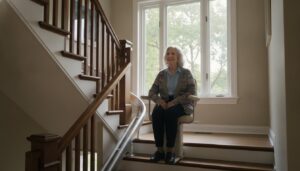
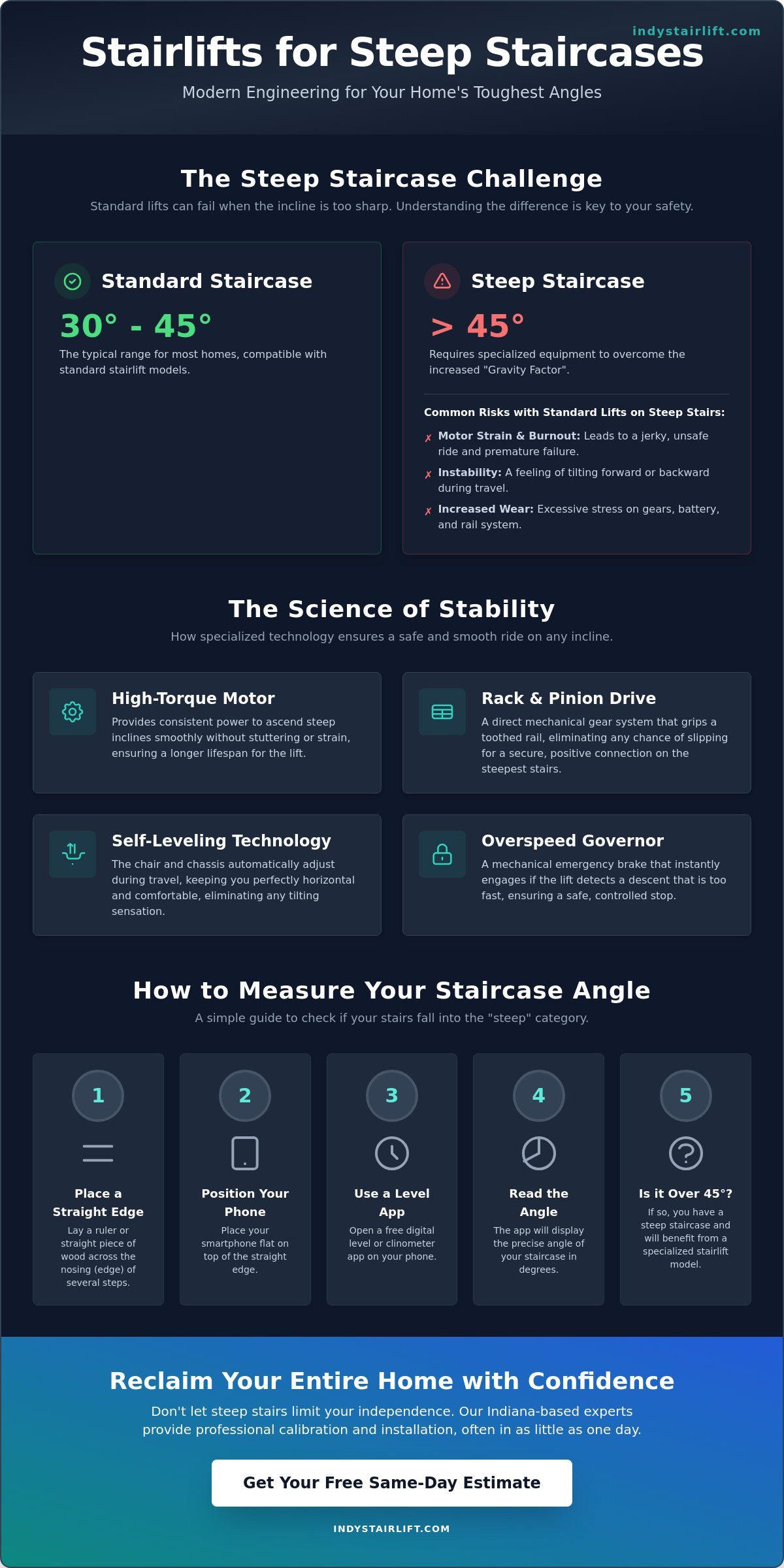
Looking at a set of stairs that feels like a cliffside is daunting. You might assume a lift is a lift, but the angle of your stairs matters immensely for your safety and comfort. In the mobility industry, we define most standard installations within a range of 30 to 45 degrees. When your stairs exceed that pitch, they fall into the “steep” category. A standard stair lift might struggle to maintain a smooth pace or feel unstable as it climbs. Choosing the wrong stairlift for steep staircase can result in mechanical strain that shortens the life of your equipment and leaves you feeling uneasy.
The “Gravity Factor” is a real physical challenge for any mobility device. On a sharp incline, the weight of the user and the chair pulls harder against the motor and the rail system. If the motor isn’t designed for high-torque output, you’ll experience a jerky, stuttering ride that feels unsafe. This mechanical stress doesn’t just feel bad; it leads to premature wear on the gears and battery. Additionally, steep stairs often have shallow treads. This means there’s less room for your feet to plant firmly when you’re getting in or out of the chair, which increases the risk of a trip. A “one-size-fits-all” approach simply can’t account for these mechanical and physical stresses.
Common Challenges in Older Indiana Homes
Our local roots mean we’ve seen it all in our community. If you live in a historic neighborhood in Indianapolis or a classic home in Lafayette, you know exactly what we mean. Many of these beautiful older properties feature unique architectural challenges:
- Utility Basement Stairs: Often built for storage access rather than daily use, these are frequently narrow and incredibly steep.
- Attic Conversions: Many homes have second stories that were added later, squeezing staircases into tiny footprints with sharp angles.
- Limited Landing Space: Steep stairs often end abruptly at a wall or a narrow hallway, making it difficult to swivel the seat and dismount safely.
If your home has these unique architectural quirks, Get Your Free Same-Day Estimate so we can evaluate your space together. We believe every corner of your home should remain accessible to you, regardless of how it was originally built.
Why ‘Off-the-Shelf’ Lifts Aren’t the Answer
Buying a generic lift online or from a national retailer can be a costly mistake for a stairlift for steep staircase. These models often risk motor burnout if they’re forced to work on inclines exceeding 45 degrees. They lack the specialized drive systems needed to keep you moving at a consistent, safe speed. Stability is another major concern. On a sharp vertical pitch, the seat must have precise leveling technology. Without it, you might feel like you’re tilting forward or backward during the ride. Our stairlifts are chosen specifically for their ability to handle these intense angles with ease, ensuring your dignity and security are never compromised.
The Science of Stability: How Modern Stairlifts Handle Sharp Pitches
When you’re dealing with a sharp vertical rise, the engineering behind your lift becomes your greatest ally. A high-torque rack-and-pinion system is the heart of a reliable stairlift for steep staircase. Unlike basic models that might use cables or belts, a rack-and-pinion system uses a toothed rail that the motor grips directly. This mechanical connection ensures a smooth start and stop, even on the most challenging inclines. It eliminates the “slipping” sensation that can cause anxiety when you’re moving between floors. To provide an extra layer of security, these units include overspeed governors. Think of this as a mechanical emergency brake. If the lift ever detects a descent that is too fast, the governor engages instantly to bring the chair to a safe, controlled stop.
Stability isn’t just about movement; it’s about how you feel while sitting in the chair. Self-leveling technology is essential for steep installations. As the rail climbs a sharp pitch, the chassis automatically adjusts the chair’s position. This keeps you perfectly horizontal regardless of the rail’s angle. Without this feature, you might feel like you’re leaning uncomfortably forward or backward. These systems rely on battery-backed reliability to ensure you’re never stranded. Because steep-slope motors work harder, they require constant charging and high-capacity batteries to maintain peak performance. While OSHA stairway regulations primarily focus on industrial safety, they highlight why steepness creates inherent risks that only professional-grade equipment can solve. If you’re unsure if your stairs can accommodate these features, you can always Get Your Free Home Assessment to have a local expert evaluate your specific layout.
Heavy-Duty Motors and Gear Ratios
The secret to a graceful climb on a steep incline lies in the gear ratios. We use specific gear configurations that prioritize torque over raw speed. This prevents the motor from straining and ensures the lift maintains a constant, safe speed of about 20 to 25 feet per minute. Professional calibration is vital here. Our technicians match the motor’s power output to the exact pitch of your stairs, ensuring a ride that feels effortless and secure. This precision prevents the jerky movements that often plague lower-quality installations.
Chassis and Seat Design for Steep Slopes
Steep stairs are often quite narrow, which can make knee clearance a concern. We solve this through offset seating. By shifting the chair’s position slightly away from the wall, we provide more room for your legs during the journey. Adjustable footrests also help by accommodating the shallow steps often found on steep inclines. When the lift isn’t in use, folding components allow the chair and footrest to tuck away tightly. This keeps the staircase clear and walkable for other family members, preserving the flow of your home.
Choosing the Right Model: Straight vs. Curved for Steep Inclines
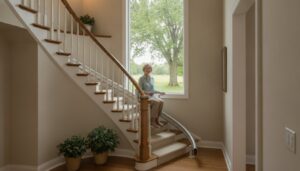
Deciding which model fits your home is a major step toward reclaiming your independence. While the steepness of your stairs is the main concern, the shape of the path determines which technology we recommend. For a stairlift for steep staircase that goes directly from one floor to the next without any turns or landings, a straight model is often the most cost-effective choice. These units are built for durability and can handle significant inclines while providing a secure, stable ride. However, if your stairs have a landing in the middle or a curve at the bottom, a curved model becomes the essential choice for your safety.
Custom-bent steel rails are the backbone of a high-quality curved installation. Unlike modular plastic systems that some national brands use, our steel rails are measured with laser precision to follow the exact contour of your wall. This maximizes the walking space left for others and ensures the chair doesn’t wobble as it transitions through a turn. While residential lifts aren’t always strictly governed by commercial ADA Accessibility Standards for Stairways, we use these rigorous guidelines as a benchmark for our safety protocols. We want to ensure your handrails and pathways remain as accessible as possible even after the lift is installed.
When a Straight Lift is Sufficient
If you have a “straight-run” staircase, you might wonder if it can handle a particularly sharp pitch. High-performance straight models are specifically engineered to manage a 50-degree incline with ease. These heavy-duty systems are perfect for handling weight on straight, steep paths without sacrificing speed or comfort. If your home features a simple but steep flight of stairs, exploring our straight stairlifts can provide the security you need at a more accessible price point. We always check the structural integrity of your stairs to ensure the rail is anchored perfectly.
The Advantages of Custom Curved Rails
For more complex layouts, custom rails are truly the gold standard. They allow us to solve the “narrow hallway” problem by using “over-run” or “90-degree” parking turns. This means the chair can travel past the top step and turn into a hallway or around a corner before you dismount. It keeps the staircase completely clear and avoids “dead zones” where a straight rail might block a doorway. If your home has a unique or winding layout, our curved stairlift guide explains how we tailor these systems to your specific architecture. To find out which model is best for your home, Get Your Free Same-Day Estimate and let us help you find the perfect fit.
How to Measure Your Staircase Angle: A 5-Step Guide
Knowing whether your home can accommodate a stairlift for steep staircase often starts with a bit of healthy curiosity. You don’t need to be an engineer to get a general idea of your home’s layout and feasibility. To start, grab a tape measure, a long straight edge like a sturdy piece of trim or a level, and your smartphone. Having these numbers ready can help put your mind at ease before a professional visit.
First, measure the ‘rise’ and ‘run’ of a single step. The rise is the vertical height of the step; the run is the horizontal depth where you place your foot. These two numbers provide the basic pitch of your stairs. Next, perform a ‘full length’ test. Pull your tape measure from the nose of the top step all the way down to the floor at the bottom. This tells us the total travel distance required for the rail. While you are measuring, look up to identify any obstructions. Bulkheads or low ceilings can affect head clearance on a sharp incline. While these DIY steps are a great starting point, professional verification is the most important step. We always perform a precision laser survey before any equipment is ordered to ensure your absolute safety.
Using Your Smartphone as a Clinometer
Your phone is a surprisingly accurate tool for measuring angles. Open a level app and place your phone on your straight edge. Make sure the board spans at least three stair treads to get an average reading. This is much more reliable than measuring just one step. A reading of 45 degrees is standard, but if your phone shows 52 degrees, you’re looking for a specialized stairlift for steep staircase with a high-torque motor. Be sure to check the angle at both the bottom and the top. In many older Indiana homes, stairs can actually get steeper as they reach the upper landing, a phenomenon known as a ‘change of pitch.’
Assessing Landing Space
The space at the top and bottom of your stairs is just as vital as the incline itself. You’ll need to measure the ‘swing’ area at the top. This ensures the chair has enough room to rotate safely so you can stand up on the landing rather than over the stairs. At the bottom, check how much room is available between the last step and the nearest wall or door. You need enough space to stand up comfortably and move away from the chair with ease. Not sure about your measurements? Get Your Free Same-Day Estimate and let us handle the technical details for you. We’ll make sure every inch is accounted for so your installation is perfect.
Reclaiming Your Home with Indiana Home Safety & Mobility
Choosing a partner to modify your home is a decision built on trust. We’ve spent years serving our neighbors across the state, which gives us a unique perspective on local housing. Whether you’re dealing with a steep basement in a historic Indianapolis home or a narrow attic climb in a country farmhouse, we’ve likely worked on a similar layout before. Our local roots mean we don’t just see a project; we see a family member who wants to stay in the home they love. We treat every stairlift for steep staircase project with the same care and respect we’d give our own parents.
Our commitment to you doesn’t end when the installation is finished. We provide a “One-Day Installation” promise to minimize disruption to your daily life. Most setups, even those with the challenging inclines we’ve discussed, are completed in just a few hours. To ensure your long-term security, we offer lifetime warranties on our products. If you ever have a concern, our 24/7 on-call support team is ready to help. You’ll never be left waiting for a national call center to get back to you because we’re right here in the community.
Professional Assessment for Steep Stairs
Precision is the key to safety on sharp slopes. We use advanced photo-survey technology to map every inch of your staircase during our initial visit. This digital blueprint ensures that your rail fits perfectly, leaving as much walking room as possible for other family members. When you work with us, you’ll meet certified technicians who live and work right here in Indiana. They take the time to explain every feature and ensure you’re comfortable before they leave. You can learn more about our stairlift installation process to see exactly how we prepare for your home’s unique needs.
Affordable Access Solutions
We believe that safety and dignity should be accessible to every homeowner. By offering factory-direct pricing, we cut out the middleman to keep costs manageable, even for custom steep-slope solutions. If a brand-new model isn’t the right fit for your current budget, we also offer pre-owned stairlifts that have been rigorously inspected and certified for safety. These units provide the same high-torque performance needed for steep inclines at a more budget-friendly price point. Ready to move safely again? Get Your Free Same-Day Estimate and let’s talk about how we can help you reclaim every floor of your home.
Take the First Step Toward a Safer Home Today
You don’t have to let a sharp incline dictate how you live in your own house. We’ve explored how specialized technology like high-torque motors and custom-bent rails can make even the most daunting climb feel effortless. By understanding the specific needs of a stairlift for steep staircase, you can move from worry to confidence. Our team at Indiana Home Safety & Mobility is locally owned and operated; we treat every home with the same care we’d give our own families.
We provide certified professional installation in as little as one day, ensuring your routine is barely interrupted. With lifetime warranties on our equipment, you can rest easy knowing your investment is protected for years to come. Your home is where your memories are, and we’re here to make sure you can continue making them on every floor. Get Your Free Same-Day Estimate and let us help you rediscover the comfort and security you deserve. You’ve navigated these challenges long enough; it’s time to enjoy the peace of mind that comes with a truly accessible home.
Frequently Asked Questions
What is considered a ‘steep’ staircase for a stairlift?
A staircase is generally considered steep if it has a pitch greater than 45 degrees. Most standard homes feature stairs between 30 and 42 degrees, but many historic Indiana homes have much sharper inclines. We specialize in finding a stairlift for steep staircase that provides the extra power needed for these angles. Identifying the exact degree of your incline is the first step we take during our initial assessment.
Can a stairlift be installed on a 50-degree slope?
Yes, we can certainly install a high-quality stairlift on a 50-degree slope. While many basic models are limited to 45 degrees, heavy-duty units are specifically engineered for these sharper vertical rises. These systems use specialized gear ratios to ensure you move smoothly and safely. We’ll verify your home’s unique pitch during our visit to ensure the equipment we install is rated for your specific staircase.
Will a stairlift on a steep staircase be slower than a standard one?
You won’t experience a slower ride just because your stairs are steep. Modern mobility solutions are calibrated to maintain a consistent, safe speed of approximately 20 to 25 feet per minute. Instead of moving slower, a stairlift for steep staircase uses a more powerful motor with higher torque. This ensures the chair starts and stops gently without any of the jerky movements that might cause you to feel uneasy.
Are there weight limits for stairlifts installed on steep inclines?
Weight limits remain robust even on steep inclines, typically ranging from 300 to 400 pounds depending on the model you choose. The steepness of the stairs doesn’t reduce the lift’s capacity as long as the motor and rail system are properly rated for the pitch. We carefully match the equipment to both your physical needs and your home’s architecture. This ensures your journey remains stable and secure every single time.
Do I need to modify my walls to support a lift on steep stairs?
You don’t need to worry about any major renovations or wall modifications. Stairlift rails are anchored directly to the stair treads, not the walls, which preserves the integrity of your home’s structure. This is true even for steep installations where the vertical pressure is higher. Because the weight is distributed across the steps, the system remains incredibly stable without requiring you to cut into drywall or your historic woodwork.
What happens if the power goes out while I’m on a steep incline?
Your safety is guaranteed even during a power outage thanks to a built-in battery backup system. The lift will continue to operate for several trips, allowing you to reach your destination safely. On steep inclines, mechanical overspeed governors also act as a secondary safety net. These emergency brakes ensure the chair never moves too fast, providing you and your family with total peace of mind regardless of the electrical situation.
Can a stairlift fit on a steep and narrow staircase simultaneously?
We can often fit a lift on stairs that are both steep and narrow by using specialized design features. Options like offset seating and folding footrests minimize the amount of space the chair takes up while in motion. This allows the lift to clear your knees and the opposite wall safely. When the lift isn’t in use, it folds up tightly to ensure the path remains walkable for everyone else.
Does a steep staircase require a custom curved rail?
A steep staircase only requires a custom curved rail if the path includes turns, curves, or intermediate landings. If your stairs are a single, straight flight that happens to be very steep, a straight rail system is perfectly sufficient and more cost-effective. However, if that steep path turns a corner at the top or bottom, a custom-bent steel rail is essential. We’ll help you determine the safest rail configuration for your layout.
Disclaimer
Indiana Home Safety and Mobility provides professional stairlift installation services for a wide range of nationwide and international stairlift brands. Each solution is selected based on an in-home, individual assessment to ensure the best fit for the customer’s specific mobility needs, home layout, and budget.
Our focus is on recommending stairlifts that offer the best combination of affordability, reliability, and low maintenance. By evaluating each situation on a case-by-case basis, we help customers choose the most practical and effective stairlift solution for safe, long-term use in their home.