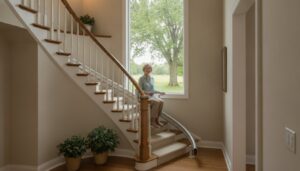
What if the very curves and turns that make your Indiana home unique weren’t obstacles, but the perfect foundation for regaining your independence? Many homeowners look at a spiral or multi-landing staircase and worry that it’s simply too narrow or complex for a modern lift. It’s natural to feel a bit of anxiety about the technical details of custom home modifications. You want to stay in the home you love, but you need to know that a solution actually exists for your specific architecture.
This guide simplifies the process of measuring for a curved stairlift, helping you understand the feasibility of your stairs before you ever commit to a project. You’ll learn why a staircase generally needs to be at least 32 inches wide and how professional 3D mapping creates a bespoke rail that fits your home’s exact geometry. We’ll walk you through the essential measurements you can check yourself and explain what to expect when a local expert visits for a detailed assessment. By the end, you’ll have the confidence to reclaim every floor of your home with a solution built specifically for you and your family’s peace of mind.
Key Takeaways
- Discover why custom-curved rails require a unique engineering approach to ensure your safety and comfort on every turn.
- Learn the simple steps for measuring for a curved stairlift to see if your staircase meets the standard 32-inch width requirement.
- Explore how professional 3D mapping provides a digital preview of your lift, ensuring a perfect fit for your home’s specific layout.
- Find practical solutions for common Indiana home challenges, such as narrow hallways in historic neighborhoods or split-level entries.
- Understand the timeline for custom fabrication and installation so you can feel prepared for your journey toward greater independence.
Why Measuring for a Curved Stairlift Requires a Specialized Approach
A Stair lift is a vital tool for maintaining independence, but not every staircase follows a simple, straight path. While straight stairs are predictable, curved staircases are as unique as a fingerprint. This is why measuring for a curved stairlift is a specialized craft that goes far beyond a basic tape measure. Unlike straight models that can often be cut to size on-site, a curved rail must be manufactured in a factory to match the exact bends, turns, and landings of your specific home. It’s a bespoke piece of engineering designed to fit your life perfectly.
Off-the-shelf measurements fail because they don’t account for the “sweep” of the rail. If a rail isn’t perfectly aligned with the radius of your turn, the chair might sit too close to the wall or stick out too far into the hallway. A custom approach ensures the rail follows the “travel path” perfectly. This path is the precise route the seat takes as it moves. By mapping this path with technical precision, we ensure the lift doesn’t just function, but feels like an integrated part of your home’s architecture. If you’re curious about the different styles available, you can learn more about our stairlifts and how they adapt to various home designs.
Understanding the Custom Rail Trajectory
When we look at your stairs, we consider whether an “inner” or “outer” curve placement is best for your comfort. An inner curve follows the tightest part of the turn, which often saves more space for other family members using the stairs. The rail must also follow the unique pitch, or steepness, of your stairs, which can change between different landings. We also plan for “parking positions.” These are the spots where the chair stops, often curving away from the steps so you can get on and off on flat ground, safely away from the edge of the stairs.
The Safety Implications of Precision
In the world of custom rail manufacturing, 1/8th of an inch is a significant distance. If the measurements are off by even a tiny fraction, the ride can feel jerky or unstable as the chair navigates a 90 or 180-degree turn. Precision eliminates these “dead zones,” providing a smooth, whisper-quiet glide. Most importantly, accurate measuring for a curved stairlift ensures you have enough clearance for your knees and feet. We want to make sure you never feel cramped or worried about brushing against a wall, giving you total peace of mind every time you move between floors.
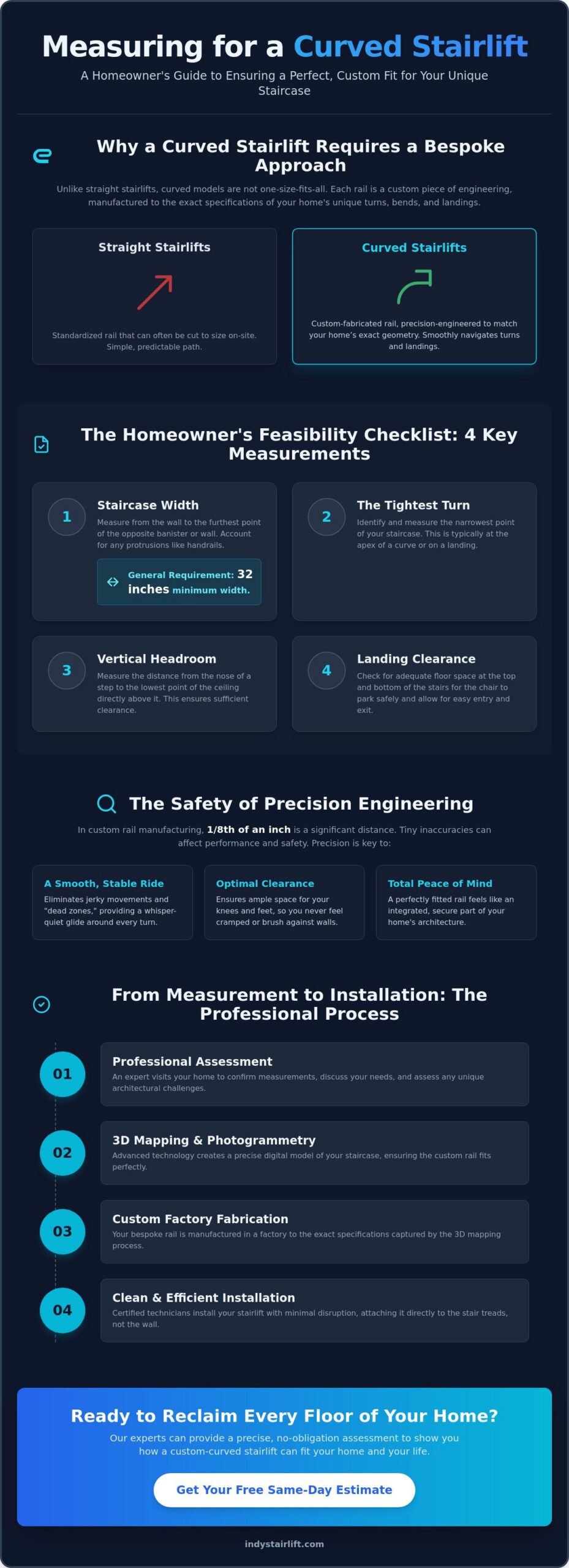
The Homeowner’s Feasibility Checklist: 4 Essential Measurements
You might look at your winding staircase and wonder if a lift is even possible. It’s a common concern for many Indiana families living in beautiful, older homes with unique layouts. While the final engineering requires specialized tools, you can perform a quick feasibility check yourself. Taking these initial steps helps reduce the anxiety of the unknown and gives you a clearer picture of how a solution fits into your daily life. When you start measuring for a curved stairlift, you aren’t just looking at wood and carpet; you’re measuring the path to your future independence.
- Step 1: Overall Width. Measure from the wall to the furthest point of the opposite banister.
- Step 2: The Tightest Turn. Find the narrowest point of the staircase, usually located right at the apex of a curve or landing.
- Step 3: Vertical Headroom. Measure from the edge of a step to the lowest point of the ceiling directly above it.
- Step 4: The Landing Clearance. Check the floor space at the very top and bottom of the flight to ensure there is room for the chair to park.
Measuring Staircase Width and Clearance
For most custom installations, 32 inches is the general requirement for a staircase to comfortably accommodate a lift. This width ensures that the chair can glide past without your knees or feet brushing the wall. Don’t forget to account for “protrusions” like handrails, thick baseboard trim, or even framed photos. If your stairs are slightly narrower, a custom rail can often be designed to hug the “inner” curve to maximize every inch. If you find that your measurements are right on the edge, you can get your free home assessment to have a local expert verify the fit for you.
Assessing the Landing Zones
The “start” and “finish” of your journey are just as important as the ride itself. At the top of the stairs, you need enough floor space to swivel the seat and exit safely onto the landing. At the bottom, we check for door interference. If your stairs end near a doorway, we look for a “folding rail” option that stays out of the way when the lift isn’t in use. Finally, identify a nearby power outlet. Since these lifts are battery-operated to ensure they work during a power outage, they need a standard plug nearby to keep the charging station ready for action. Measuring for a curved stairlift effectively means looking at the whole environment, not just the steps.
The Professional Process: 3D Mapping and Photogrammetry
After you’ve done your initial feasibility check, you might wonder how a piece of heavy steel is bent to perfectly match your home’s unique geometry. The days of relying solely on a handheld tape measure for custom rails are gone. Today, we use a sophisticated process called photogrammetry. This ensures that measuring for a curved stairlift results in a millimeter-perfect fit. It’s the difference between a “close enough” installation and a rail that feels like it was born in your hallway. This precision is what allows us to navigate those tricky 90-degree turns and narrow landings common in many Indiana homes.
When a certified technician visits for your Free Home Assessment, they don’t just look at the stairs. They use specialized digital mapping technology to scan every inch of the environment. This process is quick, non-invasive, and surprisingly fascinating to watch. It allows us to capture the exact radius of every turn and the precise angle of every landing without any guesswork. This high-tech approach eliminates the risk of human error, ensuring that when your custom rail arrives, it slides into place exactly as intended.
The Science of Digital Scanning
The technician begins by placing small, temporary reference markers on your stair treads. These markers act as anchors for the digital scanner. By taking a series of high-resolution photos from various angles, the software triangulates the exact position of every obstacle, banister, and wall. This creates a digital twin of your staircase. Within minutes, the system captures data that would take hours to record by hand. This data is then sent directly to the factory, where robotic precision is used for custom fabrication. This ensures the rail follows the curve of your stairs with absolute accuracy.
Virtual Visualization for Peace of Mind
One of the most reassuring parts of this technology is the ability to see the final result before any work begins. We can generate a 3D model on a tablet right in your living room. This allows you to review the exact trajectory of the rail to ensure it doesn’t block foot traffic. You can also adjust the parking positions at the top and bottom for the easiest entry and exit. Seeing the chair’s fold-up profile in your specific hallway removes the mystery from the process. You’ll know exactly how much space remains for other family members to walk past. It’s all about ensuring the lift enhances your lifestyle without disrupting your home’s natural flow.
Common Obstacles in Indiana Homes: Will a Curved Lift Fit?
Indiana homes are known for their charm, but historic Indianapolis neighborhoods like Meridian-Kessler or the Old Northside often feature staircases that are narrow, steep, or wrap around tight corners. If you’ve been measuring for a curved stairlift and feel discouraged by a 30-inch width or a bulky radiator at the base of the steps, don’t lose hope. Our local experience with Hoosier architecture has shown us that almost any staircase can be accommodated with the right engineering. Your home’s unique character is something to be preserved, not a barrier to your safety.
Split-level entries and multi-landing flights are also common in suburban developments across the state. These layouts often require a rail that can handle multiple 90 or 180-degree turns while maintaining a smooth ride. Whether you have a spiral design or a staircase with a mid-flight window that you don’t want to block, custom rails are designed to hug the wall or the banister as tightly as possible. This precision ensures that the lift remains a helpful tool rather than an obstruction for other family members. If you are worried about a specific architectural quirk, you can Get Your Free Same-Day Estimate to see exactly how we can work around it.
Navigating Narrow or Steep Stairs
In extremely tight spaces, every inch counts. We often utilize low-profile rails that sit closer to the wall, leaving more room for foot traffic. If the staircase is too narrow for a standard seat, an “offset” seat option can be used to position the user at a slight angle, safely clearing the banister during the turn. For those who find it difficult to bend their knees in a traditional seated position, a “perch” seat allows you to travel in a semi-standing posture. These specialized designs ensure that even the most challenging measuring for a curved stairlift results in a functional, comfortable solution.
Obstruction Solutions and Safety
Many homeowners worry about existing handrails or low-hanging bulkheads. In many cases, we can relocate a handrail or design the lift rail to serve as a sturdy support itself. We also pay close attention to safety clearances near doorways and light fixtures to ensure the lift operates without interference. Every installation we perform is designed to meet or exceed Indiana safety standards, which include specific requirements for weight capacity and overspeed protection. We take these regulations seriously because your physical protection and emotional tranquility are our top priorities. We want you to feel entirely secure from the moment you sit down until you safely reach the other floor.
Finalizing Your Plan: From Measurements to Installation
Once the technical process of measuring for a curved stairlift is complete, your journey shifts from planning to realization. The digital data from your home assessment is sent to a specialized facility where your rail is crafted with robotic precision. Because these rails are bespoke, the fabrication and shipping process typically takes a few weeks. This time allows for the careful bending of steel to match every unique turn of your Indiana home. We’ll keep you updated throughout this period, ensuring you feel supported and informed as we prepare to restore full access to your living space.
When your custom rail arrives, the actual Installation Day is surprisingly quick and clean. Most curved systems are installed in just three to four hours. Our technicians don’t mount the rail to your walls; instead, it’s secured directly to the stair treads. This method preserves your home’s structural integrity and aesthetic beauty. Once the rail is in place, we’ll spend as much time as you need showing you how to operate the lift, ensuring you feel completely confident and secure before we leave your home.
Preparing Your Home for the Big Day
You can help make the installation process even smoother by taking a few simple steps before our team arrives. Please clear the staircase of any decorative items, potted plants, or loose rugs that might create a tripping hazard. It’s also helpful to ensure a clear path from the entry of your home to the staircase so our technicians can move the equipment safely. Since your lift is battery-operated to ensure it works during power outages, we’ll need access to a standard electrical outlet near the top or bottom of the stairs to plug in the charging station. A quick check to ensure that outlet is functioning will save time on the day of the visit.
The Value of Local Indiana Expertise
Choosing a local partner means you’re working with neighbors who treat you like family. We understand the specific architectural styles of our region and take personal accountability for your long-term comfort. Unlike national call centers, we provide ongoing, local support to keep your lift running perfectly for years to come. If you’re looking for a more budget-friendly way to reclaim your home, we can also discuss a Pre-Owned Stairlift option if a compatible rail is available for your layout. Our goal is to provide a solution that fits your physical needs and your financial peace of mind. To take the first step toward a safer home, you can Get Your Free Same-Day Estimate and let us help you bridge the gap between floors.
Reclaiming Your Entire Home
Your journey toward independence doesn’t have to be complicated or stressful. By understanding the basics of measuring for a curved stairlift, you’ve already taken the first step toward reclaiming every corner of your home. You now know that 3D mapping technology eliminates errors and that even the narrowest historic stairs in Indianapolis can be navigated with a custom rail. This precision ensures your home’s character remains intact while your personal mobility is restored.
As a locally owned and operated Indiana business, we’re here to guide you through every turn. Our certified technicians provide professional one-day installations and 24/7 on-call emergency support to ensure you always feel secure. We treat your home with the same respect we’d show our own family members, focusing on your dignity and ease of use. If you’re ready to see how a custom solution can transform your daily life, we invite you to Get Your Free Same-Day Estimate today. You deserve to move through your living space with confidence and peace of mind. Let’s make your stairs a bridge to your favorite rooms once again.
Frequently Asked Questions
Can I measure for a curved stairlift myself?
You can certainly take initial feasibility measurements to see if a lift is a good fit for your home, but a professional assessment is required for the final design. While a tape measure helps you check the general width and landing space, our technicians use 3D mapping to capture the exact radius of every turn. This precision ensures that your custom rail is manufactured to fit your staircase with millimeter accuracy, which is something manual measurements can’t reliably achieve.
What is the minimum width required for a curved stairlift?
A staircase generally needs to be at least 32 inches wide to accommodate a curved lift comfortably. This measurement ensures there is enough clearance for your knees and feet as the chair glides around 90 or 180-degree turns. If your Indiana home has a narrower staircase, don’t worry. We can often use low-profile rails or offset seats to maximize your space and ensure you feel secure throughout the entire ride.
How much space does a curved stairlift take up on the landing?
Most curved lifts require about 24 to 30 inches of clear floor space at the landing to allow the chair to park and swivel safely. We often design the rail to “overrun” the top step, which moves the chair onto the flat landing floor before you stand up. This feature is essential for your personal dignity and safety, as it allows you to exit the chair well away from the edge of the stairs.
Will a curved stairlift work on a spiral staircase?
Yes, curved lifts are specifically engineered to handle the tight, continuous turns of a spiral staircase. Because the rail is custom-made to follow the exact pitch and radius of your steps, we can install a solution where a straight model simply wouldn’t work. Our 3D mapping process ensures the rail hugs the curve perfectly, preserving as much walking space as possible for other family members.
Do I need to change my stairs or walls for the installation?
No, you don’t need to make any structural changes to your home because the rail is mounted directly to the stair treads. Unlike other home modifications, this process doesn’t involve attaching equipment to your walls. This approach preserves your domestic environment and ensures the installation is clean and non-invasive. We might suggest moving a handrail if it blocks the path, but your walls and stairs remain largely untouched.
How long does it take to measure and install a custom curved lift?
The professional assessment takes about an hour, while the actual on-site installation typically takes 3 to 4 hours. Because measuring for a curved stairlift involves creating a bespoke rail in a factory, the fabrication and shipping process usually takes a few weeks. Once your custom parts arrive at our local warehouse, we schedule a quick, one-day installation to get you moving safely between floors as soon as possible.
Is there a weight limit for curved stairlifts?
Most standard curved lifts are required to support a rated load of at least 250 pounds, with heavy-duty models capable of supporting up to 400 pounds. These weight capacities are strictly governed by ASME A18.1 safety standards to ensure the motor and rail operate reliably every time. During your free home assessment, we’ll help you select a model that provides the physical protection and peace of mind you deserve.
Can the rail be installed on either side of the stairs?
Yes, the rail can be installed on either the “inner” or “outer” curve of your staircase depending on which side offers the most clearance. When measuring for a curved stairlift, our technicians evaluate the entire environment to find the trajectory that provides the smoothest ride. We’ll recommend the side that keeps the stairs as open as possible for foot traffic while ensuring you have a safe, flat area to get on and off the lift.
Disclaimer
Indiana Home Safety and Mobility provides professional stairlift installation services for a wide range of nationwide and international stairlift brands. Each solution is selected based on an in-home, individual assessment to ensure the best fit for the customer’s specific mobility needs, home layout, and budget.
Our focus is on recommending stairlifts that offer the best combination of affordability, reliability, and low maintenance. By evaluating each situation on a case-by-case basis, we help customers choose the most practical and effective stairlift solution for safe, long-term use in their home.