Imagine the relief of moving freely from your front door to your driveway without a second thought. For many families across the state, a few simple steps have become a major barrier to independence, turning a beloved home into a place of restriction. You want to provide safety and dignity for your loved one, but the uncertainty of the handicap ramp cost Indiana homeowners face can feel overwhelming. It is completely natural to feel hesitant when you are balancing a budget against the need for a secure, high-quality solution that meets local regulations.
We are here to help you find that perfect balance between affordability and peace of mind. This 2026 guide will walk you through the real factors affecting your investment, from the long-term benefits of modular aluminum to the latest updates on Indiana grants like Ramp Up Indiana. This program can be a life-changer for homeowners at or below 80% of their area’s median income. You’ll learn how to choose a design that ensures physical protection while preserving the look of your home. By the end, you’ll have a clear path toward reclaiming your space with the support of a trusted local partner. To start your journey toward a safer home, Get Your Free Home Assessment.
Key Takeaways
- Learn how your home’s unique layout and step height directly influence the handicap ramp cost Indiana families should budget for a secure entry.
- Compare the long-term value of modular aluminum versus wood to find a maintenance-free solution that stands up to Indiana’s changing seasons.
- Discover how professional, one-day installation ensures a safe slope and preserves your home’s integrity while providing immediate peace of mind.
- Explore local financial resources, including the Ramp Up Indiana grant, that make home accessibility more affordable for eligible residents.
- Understand why a personalized assessment is the most reliable way to reclaim your independence and ensure your ramp fits your specific mobility needs.
Factors Influencing Handicap Ramp Cost in Indiana
Determining the handicap ramp cost Indiana families can expect involves more than just picking a product from a catalog. Every home in our community has a unique layout, and every person’s mobility needs are personal. We want to help you understand the specific factors that shape your investment so you can make a choice that feels right for your family and your budget. It’s about more than just a structure; it’s about creating a gateway to independence that feels like a natural part of your home.
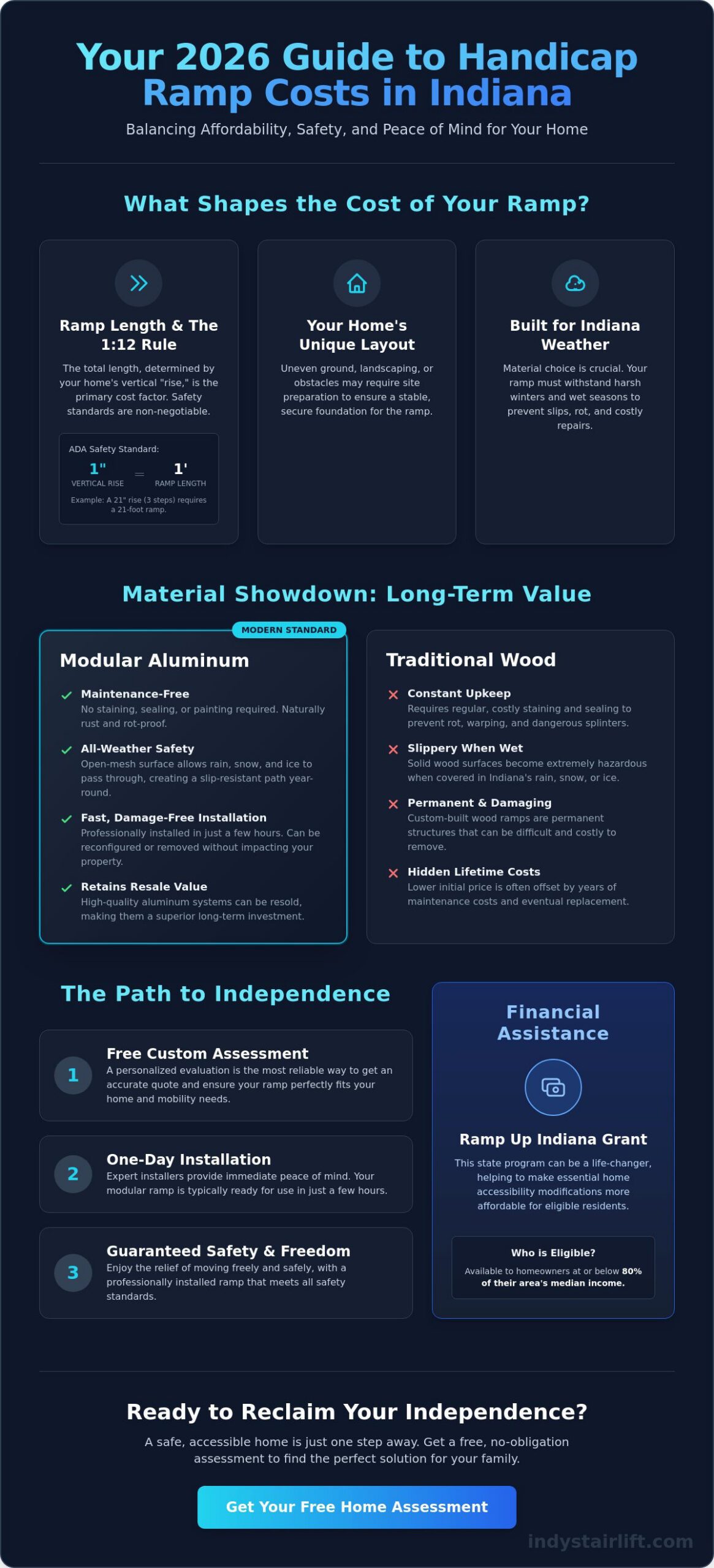
The most significant factor in any project is the total length of the ramp. This is determined by the “rise,” which is the vertical height of the steps or threshold you need to clear. Following Wheelchair ramp design standards is vital for safety and ease of use. If a ramp is too short, the incline becomes steep and dangerous. A professional installer will ensure your ramp follows the 1:12 slope ratio, which provides a gentle, manageable path for everyone. While a longer ramp requires more material, it ensures that a manual wheelchair user can navigate the incline safely without exhaustion or the fear of tipping backward.
Your yard’s current condition also plays a role in the final setup. Sometimes we need to clear away thick brush or level uneven ground before the installation begins. These small site preparations ensure the ramp sits securely on the earth. This provides a stable foundation that won’t shift over time, protecting both the user and the integrity of your property.
The Rise-to-Run Ratio: How Length Impacts Price
The 1:12 ADA standard is the gold standard for safety. This means for every one inch of vertical rise, you need one foot of ramp length. For example, if you have three steps that total 21 inches in height, you’ll need at least 21 feet of ramp. While this might seem like a lot of space, it’s essential for maintaining personal autonomy. A shallower slope is much easier to climb and much safer to descend, especially during our wet Indiana seasons. To see how this math applies to your specific entryway, Get Your Free Home Assessment.
Indiana Weather and Material Durability
When calculating the handicap ramp cost Indiana residents often overlook long-term maintenance. Our local winters are notoriously tough on outdoor structures. Traditional wood ramps might seem like a familiar choice, but they require constant staining and sealing to prevent rot and splinters. More importantly, wood can become incredibly slippery when covered in Hoosier snow or ice. Modular aluminum ramps have become the modern standard because they feature open-mesh surfaces. This design allows rain and melted snow to drain right through, creating a naturally slip-resistant path. Choosing a durable material preserves your safety and your domestic environment without the need for the heavy maintenance that “cheaper” alternatives require over time.
Choosing the Right Material: Aluminum vs. Wood vs. Portable
Deciding on the right material is a big step in reclaiming your home’s accessibility. While the initial handicap ramp cost Indiana homeowners encounter varies, the material you choose determines how much time and money you’ll spend on upkeep later. You want a solution that offers tranquility and security, regardless of whether it is raining in April or snowing in January. Each material has its place, but understanding their long-term behavior in our Midwest climate is essential for your peace of mind.
Modular Aluminum Ramps: Pricing and Benefits
Modular aluminum systems are widely considered the gold standard for modern home accessibility. They are incredibly durable and can be installed in just a few hours. Unlike permanent structures, these ramps are flexible. If your needs change, we can reconfigure or even remove them without damaging your landscaping. This flexibility preserves your domestic environment and lifestyle. Aluminum is also naturally rust-resistant. You won’t have to worry about the surface rotting or warping over time. While the market price for aluminum has seen shifts in 2026, many families find the maintenance-free nature of these ramps makes them the most cost-effective choice over the years. Plus, they often retain a resale value that wood simply cannot match.
The Hidden Costs of Wooden Ramps
At first glance, a custom wood ramp might look like a budget-friendly option. However, wood often carries hidden burdens. In Indiana, the constant moisture and temperature swings mean you’ll need to sand, paint, or seal the wood every year or two to keep it safe. Without this care, wood becomes a slip hazard, especially during our icy winters. There is also the matter of local regulations. Permanent wood ramps usually require building permits and inspections, which can add unexpected fees and delays to your project. If you are exploring financial help for these modifications, you might look into Ramp Up Indiana grants to see if your project qualifies for assistance through local non-profits.
Portable and Threshold Solutions
For smaller obstacles, portable and threshold ramps are wonderful, low-cost tools. Threshold ramps are perfect for those tiny lips at doorways that can become tripping hazards. Portable folding ramps are great for travel or temporary visiting. It’s vital to remember that these aren’t meant to replace a full home entry system. They lack the handrails and stability needed for independent, daily use on higher rises. To find out which solution fits your daily routine best, you can Get Your Free Home Assessment and talk with a local expert who understands your specific needs.
Professional Installation: Calculating the True Cost of Safety
Choosing a professional for your home modification is an investment in your family’s future safety. While you might be tempted to try a DIY approach to lower the handicap ramp cost Indiana projects require, the true cost of an error is far higher than the initial savings. A ramp that is just a few inches off in its slope can become a serious hazard for someone using a wheelchair or a walker. When you work with us, your quote includes a thorough assessment of your entryway, the highest grade materials, and the specialized labor of technicians who care about your physical security.
We believe that a professional installation is a promise of long-term stability. Beyond the technical work, you gain a local partner who is just a phone call away. If you ever need an adjustment or have a question about your ramp, we are right here in the community to help. This local accountability is something national retailers simply can’t provide. It turns a piece of equipment into a reliable tool for your daily life. Understanding the handicap ramp cost Indiana residents pay for professional service helps you see the value in a certified, worry-free setup.
The One-Day Installation Advantage
One of the biggest worries families have is the disruption of home construction. We understand that your house is your sanctuary. Our modular systems offer a significant advantage over traditional builds because they are pre-engineered for your specific space. Much like our one-day stairlift installation process, our ramp setups are designed to be fast and non-invasive. We arrive with components that fit together with technical precision. This means no loud sawing in your driveway, no construction dust in your home, and no weeks of waiting for a contractor to return to finish the job.
Safety Standards and Local Compliance
Safety is never a place to cut corners. Professional installation ensures that every inch of your path adheres to ADA guidelines for ramp construction. These federal standards exist to protect you. They govern everything from the width of the platform to the height and grip of the handrails. We also install specialized toe-guards to prevent wheels from slipping off the edge. If your yard has a steep hill or a sharp turn, we design custom landings that make the transition smooth and secure. This expertise is what allows you to reclaim your independence with total confidence in your home’s accessibility.
Financial Assistance and Grants for Ramps in Indiana
We understand that the financial aspect of home modifications can feel like a heavy weight. You want the best for your family, but you also need to be mindful of your savings. Fortunately, Indiana offers several pathways to help offset the handicap ramp cost Indiana homeowners might otherwise pay entirely out of pocket. These programs are designed to help you stay in the home you love while ensuring your daily life is safe and dignified. We are here to help you understand these options so you can focus on what matters most: your independence.
Ramp Up Indiana and IHCDA Grants
The Indiana Housing and Community Development Authority (IHCDA) manages a vital program called Ramp Up Indiana. This initiative provides grants to local non-profit organizations and government units specifically to build ramps for residents with mobility challenges. To qualify, your household income typically needs to be at or below 80% of your area’s median income. For instance, in many Indiana counties in 2026, this limit sits around $47,550 for a single person. While these grants are wonderful, they are often distributed through partners like Habitat for Humanity or your local Area Agency on Aging, such as the Area IV Agency. It’s a good idea to reach out to these groups early. Funds are limited and waitlists can sometimes grow during peak seasons.
Medicare and Insurance Coverage Realities
A common question we hear is whether traditional health insurance will help. Many families are surprised to learn that Medicare usually classifies ramps as home modifications rather than Durable Medical Equipment. This means they often don’t cover the cost directly. You can learn more about how these classifications work by reading about Does Medicare Cover Stairlifts in Indiana? as the logic is very similar for most mobility aids. When you are researching the handicap ramp cost Indiana residents typically encounter, it’s helpful to know that Medicaid waivers often bridge the gap. Indiana’s Aged and Disabled (A&D) waiver frequently provides funding for these essential safety tools for those who qualify.
For our veterans, the VA offers specific grants like the HISA (Home Improvements and Structural Alterations) grant, which can provide significant relief. If your need is only temporary, perhaps for a short-term recovery after a surgery, we also offer rental options for our modular systems. This allows you to secure your home without a permanent commitment. Whatever your situation, we are committed to helping you find a solution that fits your life. To explore your options and get a clear picture of your budget, Get Your Free Home Assessment today.
Investing in Independence: Why a Custom Assessment Matters
Reclaiming the freedom to enter and exit your own home is an emotional milestone. It represents the return of personal dignity and the end of feeling trapped by your own front porch. While we have discussed the technical details of materials and grants, the most important part of the journey is ensuring the solution fits your specific life. A ramp is not just a piece of medical equipment. It is a vital tool that allows you to remain an active part of your community and your family’s daily activities. When you look at the handicap ramp cost Indiana families invest in, you are truly investing in emotional tranquility and physical protection.
Many homeowners are tempted by “one-size-fits-all” retail ramps found at big-box stores or online marketplaces. These generic options often fail because they don’t account for the unique terrain of an Indiana yard or the specific door swings of a historic home. A ramp that is too narrow or lacks a proper landing can create new safety risks rather than solving old ones. By choosing a customized approach, you ensure that every turn and every slope is designed with your safety as the only priority. This precision is what separates a temporary fix from a long-term home modification that preserves your lifestyle.
Custom Solutions for Indiana Homes
Every house has its own character. We believe your accessibility solution should respect that. Our team focuses on matching your ramp to your home’s aesthetic while meeting every structural requirement. Working with a locally owned specialist means you get a level of personal accountability that national chains cannot match. We live in the same neighborhoods you do. We understand our local building codes and the specific challenges our weather presents to your property. You can learn more about Indiana Home Safety & Mobility and our commitment to treating every client like a member of our own family.
Taking the Next Step Toward Security
If you feel uncertain about which path to take, a free home assessment is the best way to find clarity. We sit down with you to look at your entryway, measure the rise of your steps, and listen to your concerns. Sometimes, a ramp might not be the best fit for a very tight space or a particularly high porch. In those cases, we might explore alternatives like Vertical Platform Lifts, which provide a compact way to move between levels. This assessment takes the guesswork out of the handicap ramp cost Indiana residents face by providing a clear, fixed quote tailored to your needs. We want to help you turn your house back into the sanctuary it was meant to be. To begin your path toward a safer home, Get Your Free Home Assessment today.
Reclaim Your Independence and Peace of Mind
Reclaiming the full use of your home is a journey toward liberation and personal autonomy. We’ve looked at how choosing the right materials and following strict safety standards protects your physical security. You now understand how Indiana grants and professional guidance can help manage the handicap ramp cost Indiana families encounter. Our team is locally owned and operated right here in the community. We treat every project with the technical precision and genuine compassion your family deserves.
Our certified technicians specialize in professional one-day installation to minimize disruption to your domestic environment. We also provide 24/7 on-call support because your safety shouldn’t have an expiration date. You don’t have to navigate these changes alone. We are here to act as your trusted guide, ensuring every step of the process brings you closer to emotional tranquility. Take the first step toward a more accessible and dignified lifestyle today. Get Your Free Same-Day Estimate and let’s work together to make your home a sanctuary of safety once again. You have the strength to reclaim your space, and we are honored to help you do it.
Common Questions About Handicap Ramps in Indiana
How much does a typical 10-foot wheelchair ramp cost in Indiana?
The total investment for a 10-foot ramp depends on the material you choose and the specific layout of your home’s entryway. While portable options are a common low-cost choice for travel, a professional modular system provides the stability needed for daily home access. Factors like site preparation and the complexity of the landing will influence the final handicap ramp cost Indiana homeowners see on their personalized quotes.
Does Medicare or Medicaid in Indiana pay for handicap ramps?
Medicare typically does not cover home modifications like ramps because they are classified as home improvements rather than medical equipment. However, Indiana’s Medicaid Aged and Disabled (A&D) waiver frequently provides funding for these essential safety tools for those who qualify. You might also check with long-term care insurance providers, as some policies include benefits for aging-in-place modifications.
How long does it take to install a modular aluminum ramp?
A modular aluminum ramp can typically be installed in a single day, often in just a few hours. Because these systems are pre-engineered for technical precision, our technicians can assemble the components quickly without the mess or noise of a traditional construction project. This rapid setup allows you to reclaim your independence and start moving safely almost immediately.
Do I need a building permit for a wheelchair ramp in Indiana?
Many Indiana municipalities require a building permit for permanent structures like wooden ramps, while modular aluminum systems are sometimes treated as temporary equipment. Permit fees in the state often range between $150 and $300 depending on your specific county or city. It is always best to check with your local building department or work with a professional installer who understands local regulations.
Which is better for Indiana winters: wood or aluminum ramps?
Aluminum ramps are the superior choice for Indiana winters because their open-mesh surfaces allow snow and melted ice to drain right through. Wood ramps can become dangerously slippery when wet or frozen and require constant sanding and sealing to remain safe. Aluminum provides a naturally slip-resistant path that offers tranquility and physical protection during our toughest Hoosier months.
Can I rent a handicap ramp for short-term use in Indiana?
Yes, you can rent a modular aluminum ramp for short-term needs such as recovering from a surgery or hosting a visiting family member. Rental programs offer a flexible way to ensure safety and preserve your domestic environment without the commitment of a permanent purchase. This is a practical solution that helps manage the handicap ramp cost Indiana residents face during temporary mobility challenges.
What is the ADA-compliant slope for a residential ramp?
The standard ADA-compliant slope for a residential ramp is a 1:12 ratio. This means you need one foot of ramp length for every one inch of vertical rise from the ground to the door threshold. Following this guideline is vital because it ensures the incline is gentle enough for a manual wheelchair user to navigate safely without the risk of tipping or exhaustion.
How do I apply for the Ramp Up Indiana grant program?
To apply for the Ramp Up Indiana grant, you should contact the Indiana Housing and Community Development Authority (IHCDA) or a local partner organization like a Habitat for Humanity affiliate. These grants are designed for homeowners at or below 80% of the area median income. Local non-profits facilitate the application process to help families secure the funding needed for safe home entry.
Disclaimer
Indiana Home Safety and Mobility provides professional stairlift installation services for a wide range of nationwide and international stairlift brands. Each solution is selected based on an in-home, individual assessment to ensure the best fit for the customer’s specific mobility needs, home layout, and budget.
Our focus is on recommending stairlifts that offer the best combination of affordability, reliability, and low maintenance. By evaluating each situation on a case-by-case basis, we help customers choose the most practical and effective stairlift solution for safe, long-term use in their home.