What if the biggest hurdle to staying in the home you love isn’t the stairs themselves, but a simple misunderstanding about the installation? Many Indiana homeowners hesitate to regain their independence because they worry: do stairlifts damage walls or leave behind permanent scars on their property? It’s a completely natural concern, especially when you’ve spent years maintaining your home’s character and value.
We understand that your house is more than just a building; it’s a sanctuary filled with memories. You might worry about “medicalizing” your living space or facing expensive repair bills down the road. Rest assured, modern stairlift installation is a non-invasive process designed to protect your home’s structure while providing the security you deserve. These systems act more like a piece of high-quality furniture than a major construction project, ensuring your domestic environment remains preserved.
In this guide, you’ll discover why your walls remain completely untouched during installation and how the minor marks left on your stair treads are easily fixed. We’ll walk you through the specialized process that preserves your home’s long-term value and gives you total peace of mind. Your journey toward safer, easier living doesn’t have to come at the expense of your home’s beauty.
Key Takeaways
- Discover how modern installation methods ensure your walls remain completely untouched, preserving your home’s wallpaper and paint.
- Get the facts behind the common question, “do stairlifts damage walls,” and see how tread-mounted rails keep your home’s structure secure.
- Learn about the specific ways professional installers protect the original hardwoods or carpeting in your Indiana home.
- Find out how simple it is to restore your staircase to like-new condition in under two hours if the lift is ever removed.
- Understand why factory-trained expertise is the key to a furniture-grade addition that maintains your property’s long-term value.
Debunking the Myth: Do Stairlifts Attach to Your Walls?
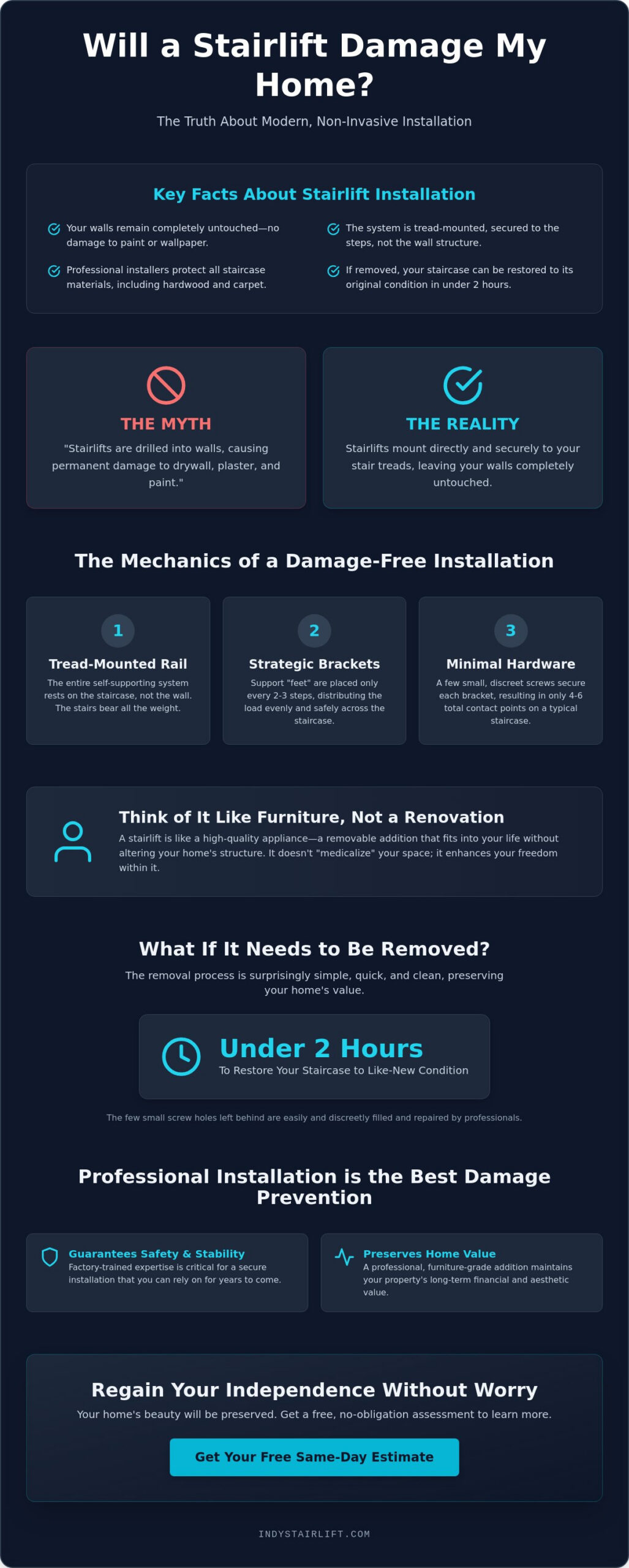
Many homeowners imagine a construction crew drilling heavy bolts into their drywall or plaster. It’s a scary thought, especially if you’ve spent years perfecting your home’s appearance. You might find yourself asking, do stairlifts damage walls or ruin my custom wallpaper? Let’s clear up the confusion right away: modern residential stairlifts are not bolted to your walls. Instead, they rely on the strength of your staircase itself. This realization often brings a huge sense of relief to our neighbors here in Indiana who want to stay in their homes without causing permanent structural changes.
Wall-Mounted vs. Tread-Mounted Lifts
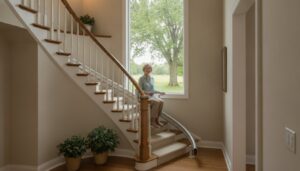
In some commercial buildings or hospitals, you might see heavy-duty lifts attached to the wall for specific industrial reasons. However, for your home, we use a much gentler approach. A tread-mounted stairlift is a self-supporting rail system. This means the weight of the unit and the person using it is transferred directly into the steps. When you look at how stairlifts attach to stairs, you’ll see that the rail sits on small brackets, often called “feet,” that rest on the horizontal part of your steps.
This design is structurally better for residential homes. Most interior walls aren’t built to support the concentrated weight of a moving lift without expensive, messy reinforcement. By using the stairs as the foundation, we avoid the need to cut into your drywall or search for studs. It’s a much cleaner method. When you choose a professional stairlift installation, your walls remain pristine. Your home’s structural integrity stays exactly as it is today.
The “Furniture” Analogy for Home Mobility
Think of a stairlift like a heavy bookshelf or a grand piano. While these items are heavy and sit on your floor, they aren’t part of the house’s “bones.” They’re high-quality additions that can be moved or removed without changing the room’s layout. We often explain that a stairlift is more like a removable appliance than a permanent renovation. It’s designed to fit into your life, not to take over your architecture.
This perspective helps ease the anxiety about “medicalizing” your home. You aren’t turning your hallway into a hospital wing. You’re simply adding a tool that helps you reclaim your space. Because the system doesn’t touch the walls, you don’t have to worry about matching paint colors or patching plaster later. So, do stairlifts damage walls? The answer is a resounding no. You get to keep your home looking exactly the way you love it, while gaining the freedom to move between floors with total confidence.
The Mechanics of Modern Stairlift Installation
Understanding how a stairlift stays in place helps take the mystery out of the installation process. While the rail looks like a permanent fixture, it’s actually a masterpiece of weight distribution. Instead of relying on your home’s vertical structures, the system uses the natural strength of your staircase. Many Indiana residents wonder, “do stairlifts damage walls?” when they see the sturdy rail system, but the secret lies in the precision of the mechanics. The rail is held up by specialized mounting brackets, often called “feet,” which are strategically placed to ensure maximum stability without invasive construction.
These feet don’t need to be on every single step. In most standard homes, our technicians place a bracket roughly every two to three steps. This spacing is calculated based on the length of the rail and the specific layout of your stairs. By spreading the load across several points, the system protects your individual stair treads from excessive wear. Once the rail is secure, the rack-and-pinion drive system allows the chair to glide along a fixed, steady path. This mechanical precision ensures that your ride is smooth and, more importantly, that the chair never wobbles or shifts toward your drywall.
Understanding Mounting Brackets and Hardware
The hardware we use is surprisingly minimal given the amount of support it provides. Each mounting bracket is secured using a few small screws, typically between three and four inches long. These screws are designed to grip the wood or subfloor beneath your carpet or hardwood. On a typical straight staircase, there are usually only four to six total points of contact where the lift actually touches your home. Most residential stair treads in Indiana are built to handle hundreds of pounds of pressure per step, so the weight of the lift is well within the safety limits of your home’s existing architecture.
Ensuring Proper Wall Clearance
One common worry is that the chair might scuff the paint or bump into a banister during use. We prevent this by using a custom-fit approach for every home. Our team uses digital photo surveys to ensure a perfect fit with zero wall contact, capturing every dimension of your staircase with mathematical precision. This data allows the rail to be positioned at the ideal distance from the wall, leaving plenty of “breathing room” for the chair to pass by safely. When the lift isn’t in use, the seat, arms, and footrest fold up tightly. This maximizes the space for other family members to walk up and down the stairs without feeling crowded. If you’re curious about how this would look in your specific hallway, you can get your free same-day estimate to see the layout for yourself.
Protecting Different Staircase Materials in Indiana Homes
Indiana is home to a beautiful variety of architectural styles. Whether you live in a historic craftsman in Indianapolis with original oak treads or a modern suburban home in Carmel with plush carpeting, your staircase is a central part of your home’s character. A common worry we hear is that installing mobility equipment might ruin these surfaces. Since we’ve already addressed the question, “do stairlifts damage walls?” by explaining that the system is self-supporting, let’s look at how we protect the actual stairs you walk on every day.
The age of your home is never a barrier to accessibility. Our technicians are trained to work with the specific structural needs of older Indiana houses, including those with narrow footprints or unique materials like concrete and steel often found in basement entries. Each material requires a tailored approach to ensure the installation is secure yet respectful of the property. We treat your home with the same respect we would give to our own family’s house, ensuring that the installation is a help, not a hindrance, to your living space.
Preserving Hardwood and Engineered Wood
For those with fine timber stairs, the thought of a single screw can be stressful. We treat your hardwoods with the same care you do. To prevent any splitting or cracking, our installers always drill precise pilot holes before securing the mounting brackets. This professional technique ensures the wood grain remains intact and strong. It’s a deliberate, careful process that prioritizes the long-term health of your wood.
If you ever decide to remove the lift, the small holes left behind are quite manageable. They are roughly the same size as the tacks used for a standard decorative carpet runner. A bit of matching wood filler and a touch of stain can make these spots nearly invisible, allowing your original floors to shine once again. We believe that your home should be able to adapt to your needs without losing its soul or its value.
Managing Carpeted Surfaces
Carpet is actually the most forgiving surface for this type of project. Because the mounting brackets sit on top of the fibers, the impact is usually limited to what we call furniture footprints. Just as a heavy sofa leaves an indent in your living room rug, the lift brackets will compress the carpet padding over time. This is a purely cosmetic change that doesn’t affect the floor underneath.
When a lift is removed from a carpeted staircase, the installation points are often hidden entirely by the pile of the rug. A quick session with a home steamer or a professional carpet cleaning can fluff the fibers back to their original height. Most homeowners find that after a thorough cleaning, you can’t tell where the brackets were originally placed. If you are ready to see how a lift would fit onto your specific staircase, get your free same-day estimate today and let us help you reclaim your entire home.
Removal and Restoration: What Happens When the Lift Comes Out?
Life is full of seasons, and the tools we use to navigate our homes might change over time. If the day comes when you no longer need your lift, the transition back to a “blank slate” is remarkably smooth. Since we’ve already shown that the answer to do stairlifts damage walls is a firm “no,” your primary focus will be on the stair treads themselves. A professional removal is a quiet, orderly process that respects your space and your schedule. We treat the removal with the same technical precision as the installation, ensuring your home is returned to its original state with minimal fuss.
Most professional removals are completed in under two hours. Our team carefully disconnects the power, removes the carriage, and disassembles the rail in sections. We strongly advise against attempting a DIY removal. The components are heavy, and the high-torque batteries require specialized handling to ensure your safety and the protection of your flooring. Letting an expert handle the heavy lifting ensures that your staircase remains in excellent condition. In many cases, if your unit is in good condition, it may even be eligible for a buy-back or recycling program, which simplifies the process even further.
Filling and Fixing Screw Holes
Once the rail is gone, you’ll see a few small holes in the stair treads where the brackets were secured. For hardwood stairs, a simple color-matched wood putty or wax stick is often all you need. You simply press the filler into the hole and wipe away the excess for a seamless finish. If your stairs are made of tile or stone, we use specialized masonry bits during installation to prevent cracking, making the eventual repair much simpler with a matching grout or epoxy. Most of these holes are roughly the diameter of a pencil and are easily concealed with standard home maintenance tools. So, while you might worry do stairlifts damage walls, the reality is that the only evidence of the lift will be a few tiny spots that are easy to mend.
The Resale Reality for Indiana Sellers
When it comes time to sell your home, an existing lift can actually be a significant asset. According to 2024 data from the Indiana Department of Health, one in four adults over the age of 65 in our state experiences a fall each year. This means many buyers are actively looking for homes that already offer safety and accessibility. Highlighting a pre-owned stairlift as a feature can broaden your buyer pool to include families caring for aging parents or individuals planning for their own future needs. You can choose to keep the lift as a “value-add” or remove it to offer a traditional look. Either way, your home’s structural value remains completely intact. To learn more about how a lift fits into your home’s future, Get Your Free Same-Day Estimate and speak with one of our local experts today.
Why Professional Installation is the Best Damage Prevention
The best way to ensure the answer to do stairlifts damage walls remains a definitive “no” is to trust the process to experts. While a general contractor is skilled at many home repairs, a stairlift is a specialized piece of equipment that requires “factory-trained” precision. Our local technicians focus exclusively on mobility solutions, which means they understand the subtle nuances of weight distribution and rail alignment. By choosing a team that lives and works right here in Indiana, you’re getting more than just a service; you’re getting a neighborly commitment to your home’s safety and integrity.
Disruption is often a major concern for families, but a professional one-day stairlift installation is designed to be as swift as it is clean. Most projects are completed in just a few hours, leaving your home exactly as we found it, but with a new sense of freedom. This efficiency is backed by the peace of mind that comes from professional oversight. Having a local team means that if you ever have a question or need a quick adjustment, help is just a short drive away. This ongoing reliability ensures your lift remains a helpful tool rather than a structural liability.
The Risks of DIY or Uncertified Installers
It’s tempting to look for ways to save on costs, but uncertified labor can lead to the very damage you’re trying to avoid. One of the most common mistakes made by untrained installers is improper leveling. If the rail isn’t perfectly aligned, the carriage can shift or vibrate during use, which may lead to scuffs on your drywall or banisters. Additionally, using improper fasteners can weaken your stair treads or cause the brackets to loosen over time. Saving a bit of money upfront on uncertified labor often leads to much higher costs in home repairs later on. Professional installation is an investment in the long-term health of your property.
Your Next Steps Toward Independence
Reclaiming your home shouldn’t feel like a major construction project. It’s about making a small, thoughtful change that has a massive impact on your quality of life. The first step is always a free home assessment to check your specific staircase. During this visit, an Indiana mobility expert will look at your stair material, measure the clearance, and answer any lingering questions you have about your home’s architecture. You aren’t remodeling your house; you’re simply adding the essential tools you need to enjoy every inch of it again. We’re here to help you move forward with confidence and tranquility. To get started today, Get Your Free Same-Day Estimate and take the first step toward a safer, more accessible home.
Regain Your Freedom Without Compromising Your Home
Regaining the ability to move freely between floors is a life-changing step that shouldn’t come with home-improvement headaches. You’ve seen that modern tread-mounted systems keep your drywall and wallpaper perfectly intact, ensuring you never have to worry: do stairlifts damage walls? By choosing a solution that treats your staircase as a foundation rather than a construction site, you’re investing in your safety without losing the character of your living space.
We are a locally owned business serving all of Indiana with the heart of a neighbor and the expertise of specialists. Our professional one-day installation by certified technicians ensures your routine is barely interrupted, while our lifetime warranties on all equipment provide long-term emotional tranquility. You deserve a home that supports your independence while remaining the beautiful sanctuary you’ve always loved.
Ready to see how easily a lift fits into your unique lifestyle? Get Your Free Same-Day Estimate today and take the first step toward a more accessible future. We’re here to help you stay in the home you love with dignity and ease.
Frequently Asked Questions
Will a stairlift leave marks on my carpet after removal?
Yes, you’ll likely see small indentations in your carpet, similar to the marks left by a heavy sofa. These “furniture footprints” occur where the mounting brackets rest on the pile. Because carpet is so resilient, you can usually fluff the fibers back up with a home steamer or a professional cleaning. Once treated, it’s often impossible to tell where the brackets were originally placed. This makes carpet one of the most forgiving surfaces for installation.
Do you have to drill into the floor to install a stairlift?
No, we secure the lift to your stair treads rather than your floor or landings. This method uses small, professional-grade screws that reach into the wood or subfloor beneath your flooring. By focusing on the stairs, we ensure the system is self-supporting and stable. This approach is why you don’t have to worry about the question: do stairlifts damage walls or ruin your structural foundation? It’s a clean process that keeps your home’s layout intact.
Can a stairlift be installed on a narrow staircase without hitting the wall?
Yes, we can install lifts on staircases as narrow as 28 inches without any wall contact. Our team uses precise digital measurements to ensure the rail sits at the perfect distance from your drywall. The chair’s seat and footrest also fold up when not in use. This design keeps your hallway clear and prevents the unit from ever scuffing your paint or banisters. You can enjoy full accessibility without feeling like your hallway has become crowded.
Is it possible to install a stairlift on stairs made of tile or stone?
Yes, professional installation is perfectly safe for tile, stone, or marble steps. We use specialized masonry drill bits to create clean, precise holes that won’t crack or chip the surrounding material. This technical precision allows us to secure the mounting brackets directly into the treads. Your beautiful stone staircase remains structurally sound and visually stunning while providing the accessibility you need. It’s a specialized task that our local experts handle with care and technical authority.
How much weight can a tread-mounted stairlift safely hold?
A standard tread-mounted stairlift can safely support between 300 and 400 pounds. The weight is distributed across several different stairs through multiple mounting brackets, which prevents any single step from taking too much pressure. Most Indiana homes are built with treads that can easily handle this load. For those who need more support, heavy-duty models are also available to ensure total security. This ensures that every user feels stable and confident during their ride.
Will installing a stairlift void my home warranty or insurance?
Installing a stairlift typically doesn’t impact your home warranty or insurance because it’s considered a non-structural appliance. Since the system is self-supporting, it doesn’t change the “bones” of your home or require major renovations. It’s always a good idea to notify your insurance provider about any home accessibility improvements. Most companies view these safety features as a positive addition that reduces the risk of accidents in the home, providing you with extra peace of mind.
Can I remove the stairlift myself if I no longer need it?
You should never attempt to remove a stairlift yourself due to the weight and complexity of the components. The carriage and rail sections are heavy and can cause injury or floor damage if dropped. Professional technicians have the right tools to safely disconnect the power and disassemble the unit without leaving a mess. Let us handle the heavy lifting so your home stays protected and your stairs remain in excellent condition for the future.
Do curved stairlifts require more wall clearance than straight ones?
Curved models might need a bit more room to navigate turns, but they are custom-built to hug the inner or outer edge of your stairs. This bespoke design ensures the rail stays as close to the steps as possible without ever touching the drywall. While the layout is more complex, the core principle remains the same: do stairlifts damage walls? No, even on custom curves, your walls stay untouched and your wallpaper remains pristine.
Disclaimer
Indiana Home Safety and Mobility provides professional stairlift installation services for a wide range of nationwide and international stairlift brands. Each solution is selected based on an in-home, individual assessment to ensure the best fit for the customer’s specific mobility needs, home layout, and budget.
Our focus is on recommending stairlifts that offer the best combination of affordability, reliability, and low maintenance. By evaluating each situation on a case-by-case basis, we help customers choose the most practical and effective stairlift solution for safe, long-term use in their home.