Did you know that ADA lawsuits have surged by 320 percent since 2013, with Indiana businesses facing average settlements of $38,000? It’s completely natural to feel a sense of anxiety when you see those figures. You’ve worked hard to build your business, and the thought of “drive-by” lawsuits or confusing 2010 Standards for Accessible Design can feel like a heavy weight. Achieving ADA compliance for small business Indiana is about more than just avoiding fines; it’s about making sure every neighbor feels welcome, secure, and valued when they walk through your doors.
We understand that the technical jargon and potential construction costs are overwhelming, but you don’t have to navigate these changes alone. This guide will show you how to protect your business while providing the personal autonomy and ease of use your customers deserve. We will provide a clear checklist of physical requirements, explain how federal tax credits can help cover your costs, and show you how to find a local partner who treats your business with the same respect reserved for family.
Key Takeaways
- Understand how ADA Title III applies to your specific location and why removing physical barriers is often simpler than you might expect.
- Learn the essential standards for your storefront entrance, including the specific ramp slopes needed to welcome every neighbor safely.
- Discover how to significantly offset your costs for ADA compliance for small business Indiana through federal tax credits and deductions.
- Compare the benefits of modular aluminum ramps and vertical platform lifts to find a space-saving solution that protects your livelihood.
- Follow a simple, step-by-step plan to audit your facility and find a reliable local partner who treats your business like family.
Understanding ADA Title III for Indiana Small Businesses
When you open a shop or a restaurant in Indiana, you’re doing more than just selling a product; you’re creating a space for the community to gather. Title III of the Americans with Disabilities Act of 1990 is the specific part of the law that ensures these spaces are open to everyone. It focuses on “public accommodations,” which is a legal way of saying any private business that provides goods or services to the public. For many owners, the idea of ADA compliance for small business Indiana feels like a daunting mountain to climb, but it is actually a series of small, manageable steps toward inclusion.
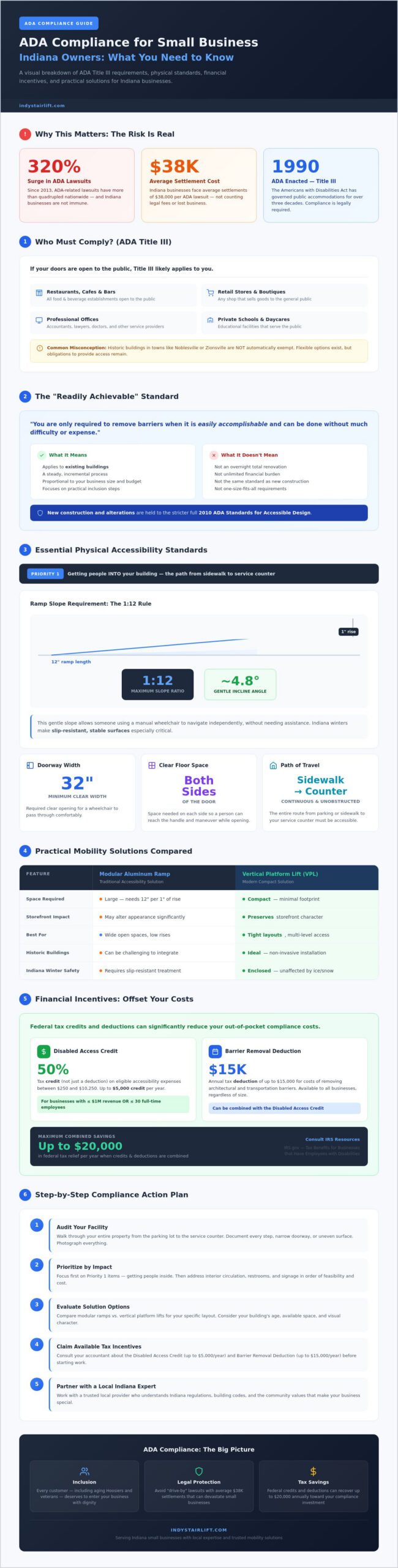
The law understands that a small local bakery doesn’t have the same budget as a massive national corporation. This is why the ADA uses the “Readily Achievable” standard for existing buildings. This means you are only required to remove barriers when it is easily accomplishable and can be done without much difficulty or expense. It’s not about an overnight total renovation. It’s about a steady journey of making your business more welcoming. When you prioritize these changes, you’re protecting your livelihood and supporting our state’s aging population and our many valued veterans who deserve to move through our communities with dignity.
Who Must Comply in Indiana?
If your doors are open to the public, Title III likely applies to you. This includes a wide range of Indiana businesses such as:
- Local restaurants, cafes, and bars.
- Retail stores and boutiques.
- Professional offices like accountants, lawyers, or doctors.
- Private schools and daycare centers.
It’s a common misconception that historic buildings in towns like Noblesville or Zionsville are exempt. While there are some flexible options for preserving historical significance, these buildings still have obligations to provide access where possible. It’s also helpful to distinguish this from Title I, which deals with how you treat your employees. Title III is strictly about the experience of your customers and their ability to use your facilities safely.
The 2010 ADA Standards for Accessible Design
When you decide to make an update or build something new, you’ll follow the 2010 ADA Standards for Accessible Design. These are the current enforceable criteria for physical accessibility in all new construction and alterations. These standards help you understand the “path of travel.” This is the continuous, unobstructed way people move from the sidewalk or parking lot, through your front door, and all the way to your service counter. If a traditional ramp takes up too much space in your layout, modern solutions like Vertical Platform Lifts (VPL) can provide a compact way to meet these standards while keeping your storefront’s character intact.
Essential Physical Accessibility Standards for Public Accommodations
The first step toward true accessibility is often the physical one right at your front door. Under the 2010 Standards, “Priority 1” focuses on simply getting people into your building. If a customer can’t get inside, they can’t experience the wonderful services you offer. For many storefronts, this means looking closely at your entry and any steps that might stand in the way. Achieving ADA compliance for small business Indiana starts with ensuring that the path from the sidewalk to your interior is smooth and unobstructed.
Ramps are the most common way to bridge these gaps. To keep your customers safe and independent, the ADA requires a specific slope ratio of 1:12. This means for every one inch of vertical rise, you need twelve inches of ramp length. This gentle incline prevents exhaustion and ensures that someone using a manual wheelchair can navigate the slope without assistance. Since our Indiana winters often bring ice and snow, it’s vital that these surfaces remain stable, firm, and slip-resistant. Choosing materials that provide extra grip during a January freeze is a thoughtful way to show you care about your customers’ physical security.
Beyond the ramp, you need to consider the doorway itself. Most doors require a clear width of at least 32 inches to allow a wheelchair to pass through comfortably. You also need “clear floor space” on both sides of the door so a person can reach the handle and maneuver while opening it. While these modifications might sound expensive, you can find helpful information on IRS Tax Benefits for Accessibility to see how the government supports these vital improvements.
Parking and Entrance Requirements
Accessibility begins before a customer even reaches your building. If you have a private parking lot, you must provide designated van-accessible spaces that include an adjacent access aisle. Once they reach the door, the threshold height is a critical detail that is often overlooked. Thresholds should be no higher than 1/2 inch to prevent tripping or catching a wheel. If you have a small lip at your entrance, threshold ramps are a simple, cost-effective fix that can be installed quickly to smooth out the transition.
Inside the Business: Counter Heights and Aisles
Once your customers are inside, they should be able to browse and interact with your team with ease. Service counters should have a section that is no higher than 36 inches above the floor to ensure everyone can reach the point of sale comfortably. Your aisles also need enough width for mobility devices to turn and pass. If your shop has different floor levels, modular aluminum ramps can be used indoors to connect these spaces without the need for permanent, messy construction. If you’re unsure where to start with your layout, you can always request a professional assessment to find the most practical path forward.
Financial Incentives: Tax Credits and Savings for Compliance
It’s completely understandable to feel concerned about the costs of making physical changes to your storefront. Many local owners worry that accessibility upgrades will strain their hard earned savings. However, the federal government provides powerful tools to help you manage these expenses. When you invest in ADA compliance for small business Indiana, you aren’t just following a rule; you’re using tax incentives designed to support your growth. While federal standards set the baseline, you can find helpful local context through the Indiana State Government’s ADA Guide, which highlights how inclusive spaces benefit our entire community.
The most significant benefit is the Disabled Access Tax Credit under Section 44 of the Internal Revenue Code. This is available to Indiana small businesses that earned $1 million or less in the previous year or had 30 or fewer full-time employees. For larger projects, the Barrier Removal Tax Deduction (Section 190) allows businesses of any size to deduct up to $15,000 per year for expenses related to removing architectural barriers. These two incentives can often be used together, significantly reducing the financial impact of your accessibility journey.
How the Section 44 Tax Credit Works
This credit is designed to be straightforward and helpful. It covers 50 percent of your “eligible access expenditures” that fall between $250 and $10,250 for the year. This means you could receive a maximum credit of $5,000 to offset your costs. Eligible expenses include a variety of practical solutions, such as:
- Removing physical barriers like steps or narrow doorways.
- Installing Vertical Platform Lifts or modular ramps.
- Providing sign language interpreters or printed materials in Braille.
- Modifying existing equipment to make it easier for everyone to use.
We always recommend speaking with a trusted Indiana CPA to ensure you’re maximizing these federal benefits for your specific situation.
The ROI of Accessibility
Investing in accessibility is a smart move for your bottom line. In Indianapolis alone, there are approximately 200,000 residents living with disabilities. By making your business easier to enter and navigate, you’re welcoming a massive group of loyal customers who are often overlooked. It’s also a vital safeguard for your business’s future. With recent ADA lawsuits in Indiana resulting in average settlements of $38,000, being proactive is much more affordable than facing a legal dispute. Plus, an accessible entrance isn’t just for wheelchair users. It’s a warm welcome for parents with strollers, travelers with luggage, and our seniors who simply appreciate a little extra security and ease of use.
Practical Mobility Solutions: Ramps and Lifts for Indiana Storefronts
Identifying the physical barriers in your shop is a great start, but the next step is choosing the right equipment to bridge those gaps. Many owners initially think of heavy concrete construction, but that can be expensive and disruptive to your daily operations. Modular aluminum systems or vertical lifts offer a much faster path to welcoming your neighbors without the mess of a construction zone. When you focus on these practical tools, ADA compliance for small business Indiana shifts from a legal worry to a rewarding investment in your community’s well being.
Indiana’s climate demands high levels of durability. Our freezing winters and humid summers can quickly wear down wood or poorly treated metal. Choosing weather-resistant materials like high-grade aluminum ensures your ramp or lift remains a reliable part of your storefront for years. Professional installation is the key to this long-term stability. A certified technician understands the technical precision required to meet weight standards and the specific 1:12 slope ratio. This expertise ensures that your solution provides physical protection and peace of mind for every customer who visits.
Vertical Platform Lifts for Small Footprints
When you have a significant height change but very little sidewalk space, a Vertical Platform Lift (VPL) is an ideal choice. These lifts can overcome elevations up to 14 feet, acting much like a small, open-air elevator for those with mobility challenges. The operation is intentionally unhurried and methodical, allowing the user to feel completely in control and secure during the transition. It is a powerful tool for promoting personal autonomy and dignity. To find the right fit for your specific entrance, you can Get Your Free Same-Day Estimate for a commercial platform lift today.
Modular Aluminum Ramps: Fast and Flexible
For many Indiana shops, the “one-day installation” of a modular system is a game changer. Traditional construction can block your entrance for a week or more, but modular aluminum ramps are pre-engineered for a quick and clean setup. They provide a sturdy, slip-resistant surface that handles our heavy lake-effect snow with ease. These systems are a top choice for achieving ADA compliance for small business Indiana because of their incredible flexibility. If your business grows and you move to a new location, the ramp can be disassembled and moved with you. This ensures that your investment in accessibility continues to provide value wherever your journey leads.
Navigating the Compliance Journey with a Local Indiana Partner
Taking the first step toward a more inclusive storefront doesn’t have to be a lonely or stressful process. By following a clear, logical path, you can transform your space into a haven of security and ease for every neighbor. Achieving ADA compliance for small business Indiana is most successful when you break it down into these five actionable steps:
- Step 1: Conduct an Assessment. Start by looking at your current facility through the eyes of someone with a mobility challenge. A professional assessment can help identify barriers you might have missed.
- Step 2: Prioritize the Path of Travel. Focus on your entrance first. Once people can get through the door, move your attention to service areas and then to restrooms.
- Step 3: Choose Durable Equipment. Select high-quality mobility solutions that offer strong warranties. You want tools that work every time, providing emotional tranquility for you and your customers.
- Step 4: Partner Locally. Work with an installer who lives in your community and understands Indiana building codes.
- Step 5: Document Your Plan. Keep a written record of your “readily achievable” improvements. This shows a good-faith effort toward compliance and protects your business’s integrity.
Why a Local Indiana Installer Matters
There is a special value in “neighborly” service that large national entities simply can’t provide. A local partner understands that our Indiana weather, from heavy lake-effect snow to summer humidity, requires specific materials and technical precision. Experts like Indiana Home Safety & Mobility are more than just contractors; they are members of your community who treat your business with the same respect they would show their own family. Choosing a local expert means you receive factory-direct pricing and the peace of mind that comes from certified technicians who are only a phone call away. We believe in providing long-term stability and personal accountability in every project we touch.
Your Next Steps Toward a Welcoming Business
Compliance is ultimately a promise to preserve the dignity and personal autonomy of every person who wants to support your business. It’s a way of saying that everyone is welcome here. Small, thoughtful changes like installing threshold ramps or widening a path can make a life-changing difference for a loyal customer. You don’t have to do everything at once; you just have to start. We are here to guide you through each step with patience and specialized expertise. To begin your journey and reclaim the full potential of your business space, Get Your Free Same-Day Estimate and let us help you create a more accessible Indiana today.
Building a More Inclusive Indiana Together
Creating a welcoming space for every customer is one of the most rewarding steps you can take as a local owner. We’ve explored how ADA compliance for small business Indiana is a manageable journey focused on removing physical barriers through “readily achievable” changes. By utilizing federal tax credits and choosing smart, modular mobility solutions, you can protect your livelihood while providing the personal autonomy your neighbors deserve. You don’t have to navigate these technical standards alone or worry about long construction delays.
As a locally owned and operated team right here in Indiana, we’re committed to your long term success. We offer technical precision with professional one-day installation and provide lifetime warranties on essential mobility equipment to ensure your peace of mind. Our goal is to help you reclaim every inch of your business space with dignity and ease. Take the first step toward a more accessible storefront by reaching out to your local experts today.
Get Your Free Same-Day Estimate
Your commitment to accessibility strengthens our entire community, and we’re honored to be your partner in this important work.
Frequently Asked Questions
Is my small business in Indiana exempt from ADA if the building is old?
No, there is no blanket exemption for old or historic buildings under Title III of the ADA. While the law respects the need to preserve historical significance, you’re still required to remove barriers if it’s readily achievable to do so. This ensures that our cherished local landmarks remain accessible and welcoming to every neighbor in the community, providing a sense of inclusion for everyone who visits.
What does “readily achievable” mean for an Indiana business owner?
Readily achievable means an action that’s easily accomplishable and able to be carried out without much difficulty or expense. This standard is flexible and depends on the specific financial resources of your business. It’s intended to protect small owners from undue hardship while encouraging a good-faith effort to improve physical security and personal dignity for all your customers.
Do I need an elevator to be ADA compliant if I have a second floor?
Most small businesses in buildings under three stories or with less than 3,000 square feet per floor aren’t required to install an elevator. However, you must still provide equal access to your services through other means. If your main offerings are on a second floor, you might consider a vertical platform lift as a compact, respectful way to help customers reclaim your entire space.
How much do ADA-compliant ramps or lifts typically cost?
The cost of accessibility equipment varies based on the height of the rise, the materials you choose, and the specific layout of your storefront. Modular aluminum ramps are often more cost-effective than permanent concrete construction because they require less labor and time. To get an accurate picture for your budget, it’s best to request a professional assessment that considers your unique environment and needs.
Can I get a tax credit for making my Indiana business accessible?
Yes, the federal Disabled Access Credit provides a tax credit for 50 percent of eligible expenditures between $250 and $10,250 each year. This is specifically available for small businesses with 30 or fewer employees or total revenue under $1 million. Using these incentives makes achieving ADA compliance for small business Indiana a much more affordable and rewarding investment in the future of your local community.
Are there specific ADA parking requirements for small lots in Indiana?
Even the smallest parking lots must provide at least one van-accessible space to remain compliant with federal standards. This space must be located on the shortest accessible route to your storefront entrance and include a clearly marked access aisle. Providing a safe and convenient place to park is a vital first step in ensuring your customers feel secure and valued from the moment they arrive.
What is the penalty for non-compliance with the ADA in Indiana?
Federal civil penalties for a first violation can reach up to $75,000, with subsequent violations rising as high as $150,000. Beyond these fines, Indiana businesses often face private lawsuits that result in average settlements of $38,000. Being proactive about ADA compliance for small business Indiana protects you from these heavy financial burdens while opening your doors to a wider, more loyal customer base.
How wide must a door be for ADA compliance at my shop?
For a shop door to be accessible, it must provide a clear opening width of at least 32 inches when the door is open at a 90-degree angle. This width allows most mobility devices to pass through comfortably without a loss of personal dignity. If your current door is too narrow, simple modifications or offset hinges can often solve the problem without a renovation.
Disclaimer
Indiana Home Safety and Mobility provides professional stairlift installation services for a wide range of nationwide and international stairlift brands. Each solution is selected based on an in-home, individual assessment to ensure the best fit for the customer’s specific mobility needs, home layout, and budget.
Our focus is on recommending stairlifts that offer the best combination of affordability, reliability, and low maintenance. By evaluating each situation on a case-by-case basis, we help customers choose the most practical and effective stairlift solution for safe, long-term use in their home.