Imagine the relief of seeing your front door not as a barrier, but as a welcoming gateway that respects your independence. For many Hoosier families, the reality of a new mobility challenge often comes with the immediate worry of how much it will cost to make the home safe again. Understanding the modular wheelchair ramp cost Indiana homeowners face in 2026 is the first step toward reclaiming your freedom of movement. You shouldn’t have to choose between a safe entryway and your financial peace of mind. It’s completely normal to feel overwhelmed by technical jargon like ADA slope requirements or to worry about whether a ramp will survive a harsh Indiana winter.
We are here to help you navigate these choices with the care and expertise of a good neighbor. This guide provides a clear, compassionate breakdown of everything involved in your investment, from material choices to installation logistics. You’ll discover how different factors influence the final price, how to ensure your ramp meets current safety standards, and the best ways to keep your project affordable without sacrificing the security you deserve. Our goal is to replace your uncertainty with a solid plan for a safer, more accessible home.
Key Takeaways
- Learn why modular aluminum designs are the preferred choice for Indiana homes due to their flexibility and quick installation without permanent modifications.
- Understand how the height of your entryway and the 1:12 slope rule directly impact your modular wheelchair ramp cost Indiana estimate.
- Compare the long-term savings of maintenance-free aluminum against the hidden annual costs of treating wooden ramps in our local climate.
- Get a step-by-step guide on measuring your home’s “rise” and navigating local HOA rules to ensure a smooth, permit-ready installation.
- Discover the benefits of working with a local Indiana team that provides compassionate, no-pressure guidance tailored to your family’s specific mobility needs.
Understanding the Value of Modular Wheelchair Ramps for Indiana Homes
Choosing a ramp is a deeply personal decision for your family. A modular ramp isn’t like a traditional wooden structure that’s hammered into your porch. It’s made of pre-fabricated aluminum sections that our team bolts together right on your property. These systems don’t require permanent concrete footings or deep holes in your yard, which makes them a cornerstone of Accessible housing strategies across the state. When you think about the modular wheelchair ramp cost Indiana families invest, you’re buying more than just equipment. You’re buying the dignity of a safe exit and the peace of mind that comes with knowing you can leave your home whenever you wish.
In growing communities like Carmel and Fishers, homeowners are moving away from bulky, permanent structures. They want solutions that look professional and respect the look of their neighborhood. Aluminum is quickly replacing wood because it offers a clean, modern appearance while ensuring you can stay in the home you love for years to come. Understanding the modular wheelchair ramp cost Indiana homeowners usually plan for involves looking at how these systems protect your future independence without making your home feel like a clinical environment.
The “Modular” Advantage: Flexibility and Resale
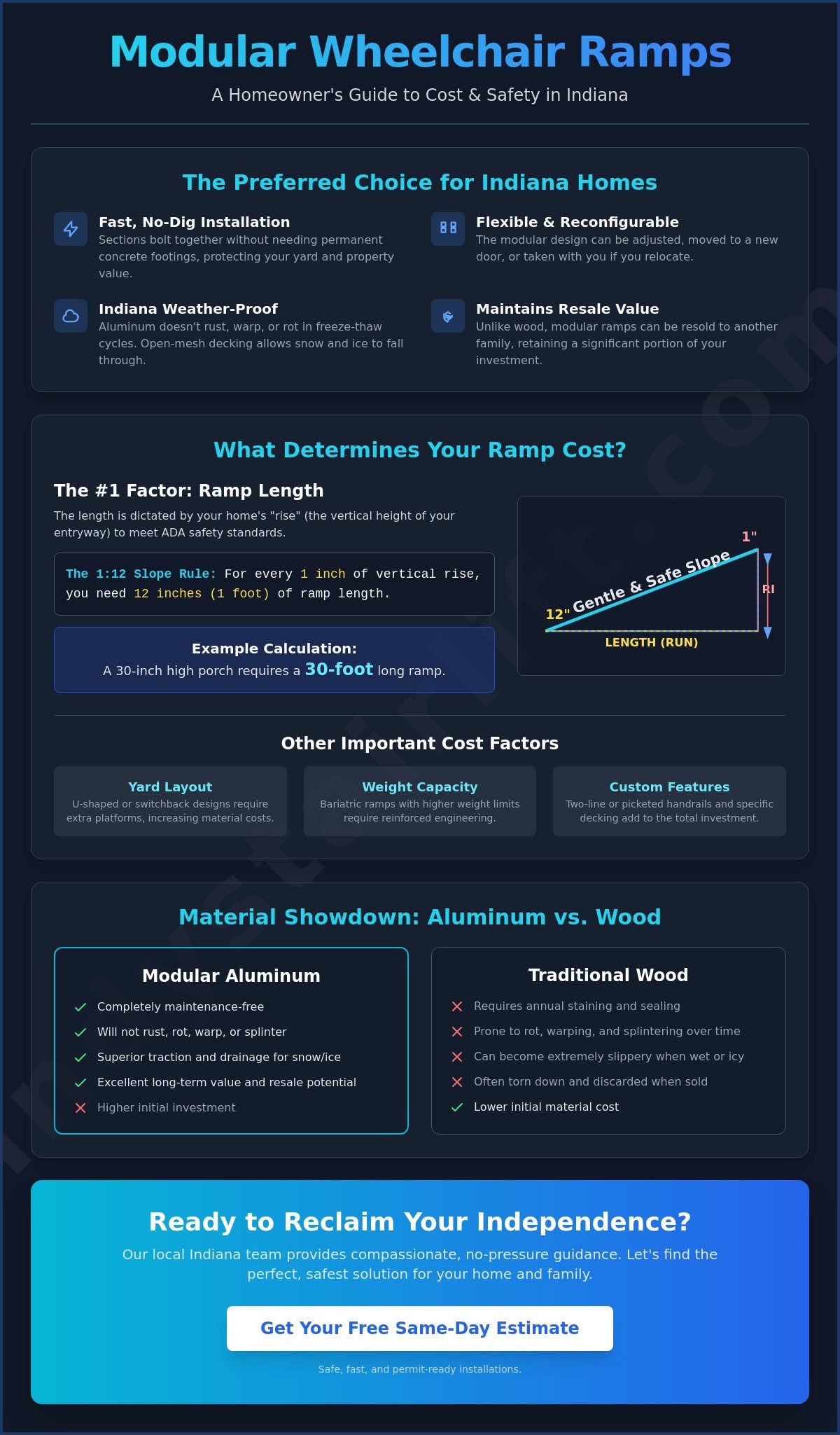
Your needs might change over time, and a modular system is designed to change with you. If you need to move the ramp to a different door or adjust the layout, we can simply unbolt the sections and rearrange them. This flexibility preserves your home’s curb appeal and property value. Unlike custom wood ramps that are often torn down and discarded when a house is sold, aluminum modular ramps retain their value. You can even take the ramp with you if you move, or sell it to another family in need when it’s no longer required.
Weathering the Indiana Seasons
Indiana winters are notoriously tough on outdoor materials. The constant freeze-thaw cycle causes wooden joints to expand and contract, which eventually leads to rot and instability. Aluminum doesn’t rust or warp, making it much more reliable for our climate. Our ramps feature open-mesh surfaces that allow lake-effect snow and ice to fall through instead of accumulating. A high-quality modular ramp prevents the “house arrest” that often happens when a traditional porch becomes too slippery or dangerous to use during the winter months. This reliable traction ensures you can navigate your entryway with confidence, regardless of what the Indiana weather brings.
Breaking Down the Cost: What Determines Your Modular Ramp Investment?
When you begin looking at the modular wheelchair ramp cost Indiana homeowners prioritize, the most significant factor is almost always the length of the ramp. This is determined by the “rise” of your entryway. According to standard ADA ramp specifications, a safe slope requires 12 inches of ramp for every 1 inch of vertical rise. If your front porch is 24 inches high, you’ll need at least 24 feet of ramp to ensure the incline is gentle enough for safe use. Longer ramps naturally require more material and more labor, which shifts the total investment required to make your home accessible.
The layout of your yard also plays a role in the final price. A simple straight run is the most straightforward to install. However, if your property has limited space, we might need to design a “switchback” or a “U-shaped” configuration. These layouts require resting platforms or landings, which add to the complexity and the amount of aluminum needed. We also consider your specific mobility needs. While a 36-inch width is standard, some families require heavy-duty bariatric ramps with higher weight capacities. These involve reinforced engineering to ensure absolute safety and peace of mind for the user.
Material Quality and Engineering
Choosing high-grade aluminum is a smart long-term move for your family. While the initial cost might be higher than a basic wood build, you won’t spend your weekends staining or repairing it. You can also customize your safety features to match your home. For example, a two-line handrail provides extra security, while picketed rails offer a more traditional look. We also offer different decking options. Open-mesh surfaces are excellent for Indiana’s snowy winters, as they prevent ice buildup, whereas solid surfaces might be preferred for smaller-wheeled mobility aids.
Additional Financial Considerations
Beyond the equipment itself, remember to factor in local permit fees. In Indianapolis and surrounding townships, these fees typically range from $50 to $300 depending on your specific municipality. You might also need minor site preparation before our team arrives. If your yard isn’t level, we may need to install a small concrete pad or level the ground to ensure the ramp is perfectly stable. You can check our FAQ page for more details on how to prepare your home for a new ramp. If you’re ready to see exactly what your specific layout would require, you can get your free home assessment to get a clear picture of the project.
Comparing Costs: Aluminum Modular Ramps vs. Wood and Concrete
Many families we talk to initially consider a wooden ramp because it feels familiar and matches their existing deck. However, when you look at the total modular wheelchair ramp cost Indiana households experience over several years, aluminum often emerges as the more compassionate choice for both your safety and your wallet. A professional wooden build can be expensive to construct, and it begins to age the moment the first Hoosier rain hits it. Concrete is even more permanent, which can be a drawback if you ever plan to sell your home to someone who doesn’t need accessibility features. It’s a permanent change that’s very difficult and costly to reverse.
Choosing the right material is a fundamental part of Growing Older at Home successfully. Aluminum ramps are engineered to last 20 years or more, while wooden structures in our climate often show signs of structural rot within 7 to 10 years. Because aluminum doesn’t warp, splinter, or rust, it remains a reliable tool for your independence year after year. You won’t have to worry about the ramp becoming a safety hazard just as you’ve grown accustomed to using it.
The Rental Option: When It Makes More Financial Sense
If you’re recovering from a surgery or only need help for a few months, you don’t necessarily need to buy a permanent system. Rental programs in Indiana are a wonderful way to get the security you need without a long-term commitment. You typically pay an installation fee and a monthly recurring cost for as long as the ramp is in place. It’s a flexible way to handle temporary mobility challenges without a large upfront investment. If you’re looking for other ways to save on your mobility project, you can also explore our pre-owned stairlifts for budget-friendly interior solutions.
Total Cost of Ownership Over 5 Years
When we look at the 5-year financial picture, the differences between materials become very clear. We want you to have all the facts before you decide:
- Wooden Ramps: You’ll face the initial build cost plus an estimated $200 to $500 every year for staining and sealing. Over five years, you might also need to replace soft boards, and you’ll eventually pay for demolition when the ramp is no longer needed.
- Aluminum Modular Ramps: Your main investment is the initial purchase. There are no annual treatment costs, and the modular design offers a “hidden profit.” Because the sections aren’t permanent, you can sell the ramp later, significantly lowering your net cost.
- Concrete Ramps: These are high-cost, permanent installations. They can’t be moved or sold. They often decrease a home’s resale value for buyers who don’t require a ramp, making them the most expensive option in the long run.
Our team is dedicated to helping you find the most logical path forward for your family’s unique situation and budget.
Planning Your Installation: Local Regulations and Site Prep in Indiana
Preparing your home for a ramp is a step-by-step process that ensures your new entryway is both safe and legal. The first step is measuring the “rise,” which is the total vertical distance from the ground to the top of your door threshold. This measurement is the foundation of your project because it determines the total length of the ramp and, by extension, the total modular wheelchair ramp cost Indiana homeowners should expect. Once you have this number, you can begin to visualize where the ramp will sit in your yard or driveway and how it will interact with your existing landscaping.
Before we turn a single bolt, it’s vital to check with your local city ordinances and Homeowners Association (HOA). Every Indiana township has its own set of rules regarding how far a structure can sit from the property line. We also look at your yard’s natural drainage and the location of underground utilities. A professional assessment ensures your ramp doesn’t block a water runoff path or sit directly over a gas line that might need servicing later. We take these precautions to protect your home’s integrity and your long-term peace of mind.
ADA Guidelines for Indiana Residential Ramps
While some homeowners think a simple incline is enough, true safety requires specific landing zones. We follow standards that call for 5×5 foot level landings at the top and bottom of the ramp. These flat areas give you a safe place to stop, open the door, or rest without the chair rolling backward. Handrails are another essential feature. They must be easy to grip for both the user and a caregiver, providing a steady anchor during Indiana’s more humid or icy days. You can learn more about our professional installation process to see how we bring these safety standards to life.
HOA and Neighborhood Considerations
Many Indiana families worry that a ramp will cause friction with their HOA board. One of the best arguments for a modular system is its “temporary” nature. Because these sections are bolted together rather than set in concrete, they are often much easier to get approved than a permanent wooden structure. You can explain to your board that the ramp preserves the home’s original structure and can be removed without a trace in the future. We offer styles and colors that blend beautifully with Midwest architectural aesthetics, ensuring your home remains a source of pride. If you’re ready to start planning your project, get your free same-day estimate today to see how we can make your home accessible and compliant.
Indiana Home Safety & Mobility: Your Local Partner for Independence
Choosing a mobility solution is about much more than just the physical equipment. It’s about reclaiming your personal autonomy and the emotional tranquility that comes with a safe, secure home. When you’re researching the modular wheelchair ramp cost Indiana providers offer, it’s easy to feel like just another number to a large national franchise. We take a different approach. As a locally owned business, we prioritize accountability and genuine compassion in every interaction. We don’t use high-pressure sales tactics because we believe our expertise and commitment to your safety should speak for themselves.
Our team understands that every home and every family’s needs are unique. We offer factory-direct pricing, which means we skip the middleman to help keep your investment as manageable as possible. This direct connection also allows us to maintain strict quality control over every section of aluminum we install. Our relationship with you doesn’t end when the last bolt is tightened. We provide a lifetime warranty and 24/7 support because we want you to feel protected and supported for as long as you live in your home. You deserve a partner who is just a phone call away whenever you have a question or need a safety check.
A Neighborly Approach to Mobility
We are proud to serve our fellow Hoosiers across the entire state, from the neighborhoods of South Bend all the way down to the banks of the Ohio River. There is a significant difference between a distant corporation and a local guide who understands Indiana’s specific needs. We treat our clients with the same respect and patience we would show our own family members. Our roots are deep in this community, and our reputation is built on the physical security and peace of mind we provide to our neighbors. You can read more about Indiana Home Safety & Mobility to see how our local focus makes a difference in your experience.
Get Started with a Free Same-Day Estimate
Taking the first step toward a more accessible home should be a comforting, stress-free experience. During a free home assessment, one of our experts will visit your property to perform precise measurements and identify the most logical path for your new ramp. We look for potential hazards and ensure the layout provides the maximum ease of use for your specific mobility aid. We believe in transparent pricing, so the quote you receive is what you’ll pay. There are no hidden fees or surprise add-ons waiting for you at the end of the project. We are here to help you reclaim your living space with confidence. Get Your Free Same-Day Estimate today and let us help you move toward a safer, more independent future.
Take the Next Step Toward Home Accessibility
Reclaiming your home’s entryway is a powerful move toward maintaining your independence and peace of mind. We’ve explored how the modular wheelchair ramp cost Indiana homeowners invest is balanced by the long-term durability and flexibility of aluminum systems. By choosing a solution that stands up to our local weather and meets all safety standards, you’re ensuring your home remains a place of security for years to come. You deserve to feel confident every time you cross your threshold.
Our team at Indiana Home Safety & Mobility is proud to be your local guide in this journey. We are locally owned and operated right here in Indiana, offering one-day professional installation by our own certified technicians. Our maintenance-free, marine-grade aluminum construction means you can focus on your lifestyle instead of home repairs. We invite you to Get Your Free Same-Day Estimate to see how simple it is to transform your living space. You don’t have to navigate these changes alone; we are here to support you every step of the way.
Frequently Asked Questions
How much does a modular wheelchair ramp cost per foot in Indiana?
The cost per linear foot for a ramp depends on the material grade and the specific safety features you choose for your home. While the total length is dictated by the height of your porch, the modular wheelchair ramp cost Indiana families plan for includes the pre-fabricated sections and the professional engineering required for a safe slope. We provide clear, personalized quotes that reflect the exact layout of your property and the total footage needed to ensure a gentle, secure incline.
Does insurance or Medicare cover the cost of a modular ramp in Indiana?
Traditional Medicare generally considers a wheelchair ramp to be a home modification rather than durable medical equipment, so it’s rarely covered. However, some Indiana Medicaid waiver programs or specific long-term care insurance policies may provide financial help for these safety improvements. It’s a good idea to speak with your insurance coordinator to see if your policy includes benefits for home accessibility modifications that support independent living.
How long does it take to install a modular aluminum ramp?
Most modular aluminum ramps can be fully installed in just one day. Because the sections are pre-fabricated and don’t require permanent concrete footings, our team can assemble the entire system quickly and efficiently. This fast turnaround means you won’t have to deal with a long, messy construction project, and you can begin using your new, safe entryway almost immediately after we arrive.
Are modular ramps safer than wooden ramps in the winter?
Modular aluminum ramps are much safer during our Indiana winters because they feature an open-mesh surface. This design allows lake-effect snow and ice to fall through the slats instead of piling up and creating a slippery hazard. Wooden ramps tend to trap moisture and can become dangerously slick when frozen, whereas the textured aluminum surface provides consistent, reliable traction even in the harshest winter weather.
Can I install a modular ramp myself to save on costs?
While some homeowners consider a DIY approach, professional installation is the best way to ensure the ramp is safe and meets all slope requirements. A ramp that is too steep or improperly anchored can be very dangerous for the user and may not comply with local Indiana building codes. Our certified technicians have the expertise to ensure every bolt is secure and the path is perfectly level for your peace of mind.
What is the resale value of a used modular aluminum ramp?
High-quality aluminum ramps retain significant value because the material doesn’t rust, warp, or rot like wood. If your mobility needs change or you move to a new home, the modular sections can be disassembled and sold to another family in need. This resale potential is a major financial benefit that helps lower the net modular wheelchair ramp cost Indiana homeowners experience over the life of the system.
Do I need a building permit for a modular wheelchair ramp in Indianapolis?
Yes, most municipalities in and around Indianapolis require a building permit for a ramp installation. Permit fees for these types of structures typically range from $50 to $300 depending on your specific township or city ordinances. We are familiar with the local requirements throughout Indiana and can help you understand the steps needed to ensure your ramp is fully permitted and compliant with local laws.
Can I rent a modular ramp instead of buying one?
Renting is a wonderful, flexible option if you only need a mobility solution for a few months of surgery recovery or a temporary living situation. Our rental programs allow you to have a professional, high-quality ramp installed without the upfront cost of a full purchase. You’ll pay an installation fee and a simple monthly recurring cost for as long as the ramp is needed at your home.
Disclaimer
Indiana Home Safety and Mobility provides professional stairlift installation services for a wide range of nationwide and international stairlift brands. Each solution is selected based on an in-home, individual assessment to ensure the best fit for the customer’s specific mobility needs, home layout, and budget.
Our focus is on recommending stairlifts that offer the best combination of affordability, reliability, and low maintenance. By evaluating each situation on a case-by-case basis, we help customers choose the most practical and effective stairlift solution for safe, long-term use in their home.